New Mexico. Exploring the Cosmos from the Plains of Agustin
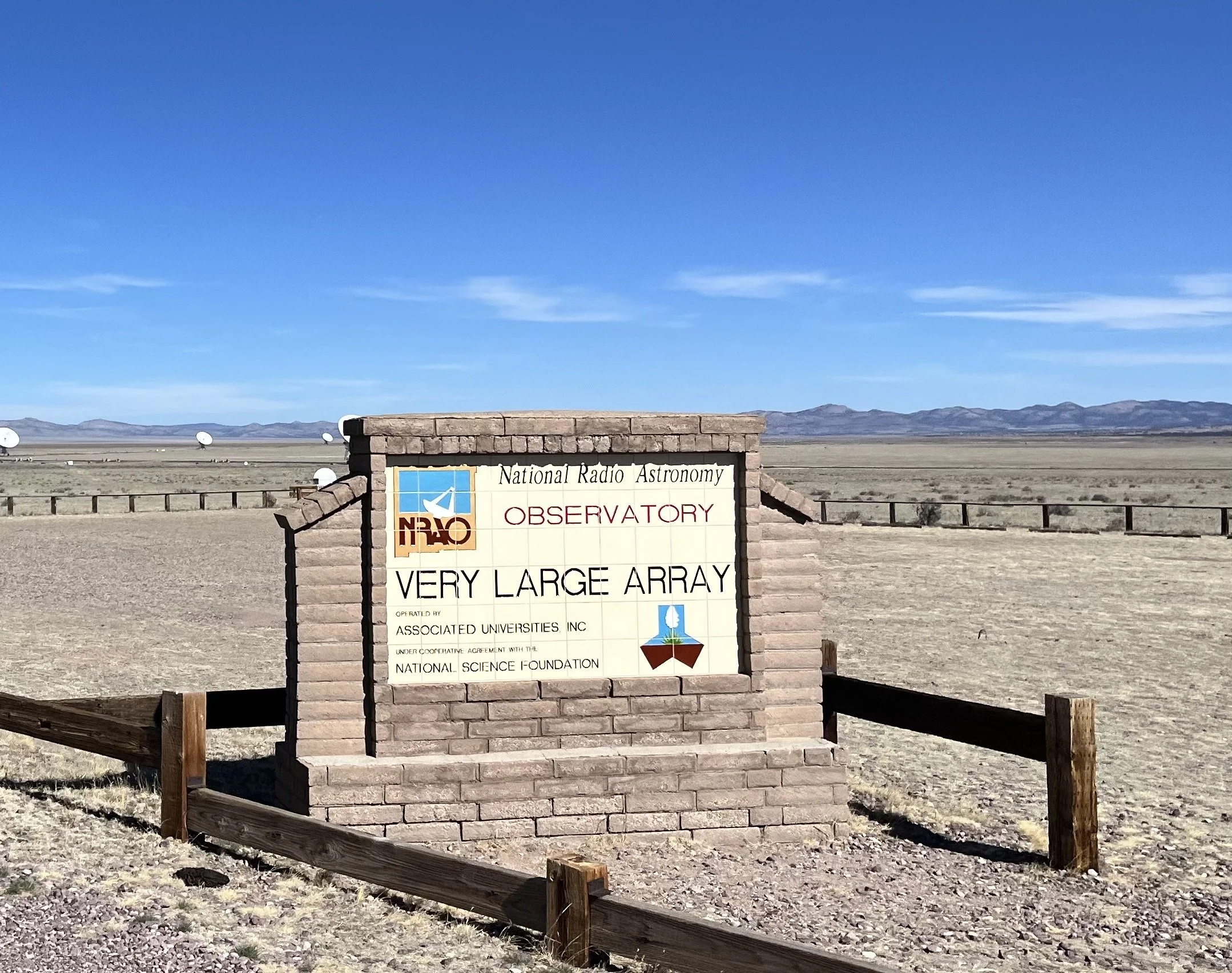
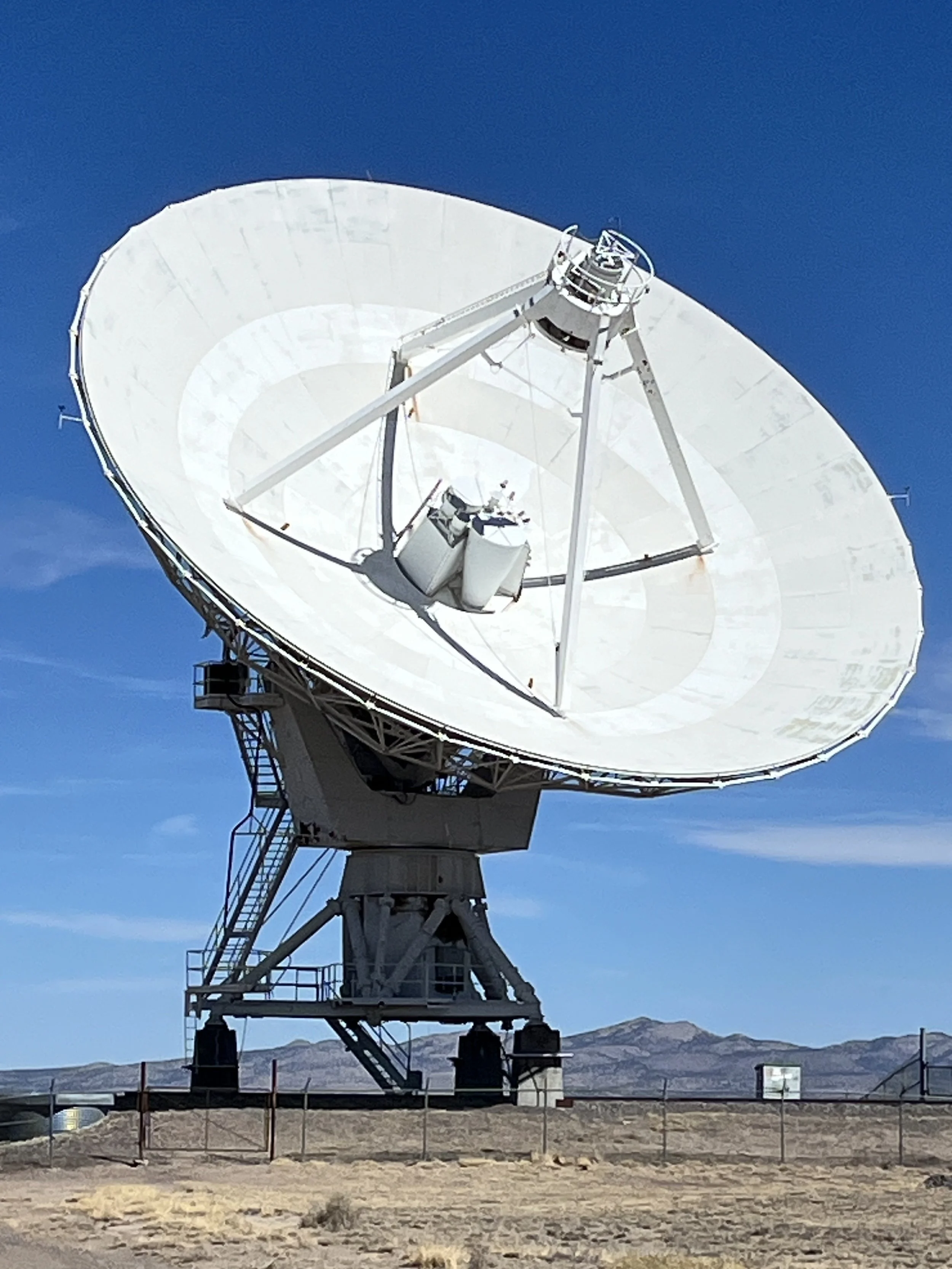
On a recent road trip to California my wife and I decided to forego our usual path through central New Mexico (U.S. Interstate 40) in favor of a more southernly route. U.S. 60 is a two-lane highway and not especially well traveled. After negotiating Magdalena Pass (named by Spanish soldiers who saw the profile of a woman in the rock), we descended towards a massive valley. In the center was the odd sight of large parabolic dishes positioned in radiating lines. After another 20 minutes of driving, we approached a sign marking the turnoff for the “Very Large Array Radio Telescope (VLA).” I know what a radio telescope is, but what exactly is a “large array”? Google revealed an array to be a set of individual receivers that together function as a telescope by receiving electromagnetic energy reflected or emitted from distant objects. The VLA has 28 dishes found along three railroad tracks that form a massive Y-shape. With a diameter of 25-meters, each dish can receive electromagnetic signals within the 0.6-centimeter to 410-centimeter (50-73 MHz) spectrum. An advantage of radio telescopes is that the signals can penetrate space gas and dust as well as Earth’s atmosphere with minimal distortion. VLA receiver elements are cooled by an air-conditioner that keeps temperatures at 4 Kelvin (-269°C) using a closed loop helium cryogenic system.
Astronomers use the VLA to explore young stars, black holes, and other celestial bodies. The VLA can also look at quasars, pulsars, supernovas, and far away galaxies and complete surveys that involve about 80% of the Earth’s sky. The VLA is controlled by scientists and technicians at the Pete V. Domenici Science Operations Center, 80 kilometers west in Socorro, NM.
So why here, in this remote place? The answer has to do with limited interference from cities and other human activities. Cosmic radio waves are billions of times weaker than broadcast waves so radio telescopes must be positioned in places where there is minimal interference. The VLA was constructed within a valley called the Plains of Agustin that is positioned within a graben, a down-thrown block of the earth’s crust bordered by parallel faults. The dry desert climate is also ideal for radio telescopes because water molecules in more humid locations distort radio waves.
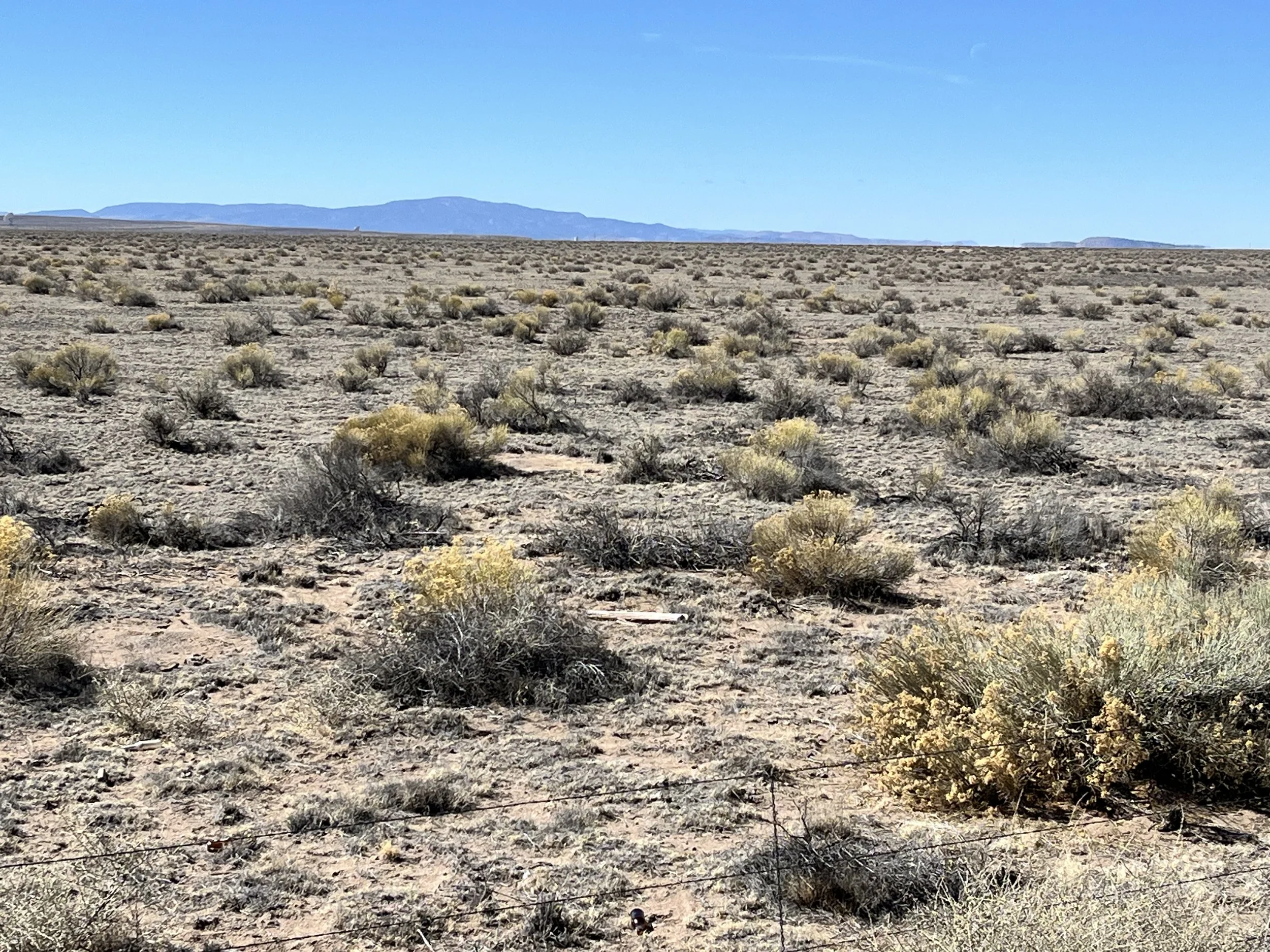
Extending northeast to southwest, the Plains of Agustin are south of the Colorado Plateau and surrounded by mountains. Sometime between 11,000 and 23,000 years ago a lake called San Agustin covered part of the valley. As the valley grew drier 13,000 years ago Lake San Agustin was replaced by ephemeral (seasonal) lakes. The area’s human occupation extends back to the Clovis and Folsom periods (10,999 BC to 5,999 BC). Archaeologists have found evidence of early crop production including maize, beans, and squash. Today the region is still sparsely populated with the two closest towns being Magdalena to the east and Datil to the west.
Weighing 209 metric tons, each dish within the VLA is mounted on a moveable cart that rides on railroad tracks. In addition to being moved, antennas can be repositioned for specific sky angles and azimuths (directions). Each arm of the Y-shaped track is 21 kilometers long, allowing for the array to be arranged in predetermined positions ranging from “A” through “D” configurations. In configuration “D” the dishes are closest together (600 meters) and in “A,” farthest apart (36 kilometers). The larger the array (position A), the bigger its “eye” and the more detail it can see. With a resolution of 0.04 arc seconds, the VLA can detect a golf ball 150 kilometers away. When the array is smaller (position D) it sees a larger piece of the sky but in less detail. A supercomputer combines data collected by each dish into a coherent image. The arrangement of array elements is cycled through configurations A through D every 3-4 months.
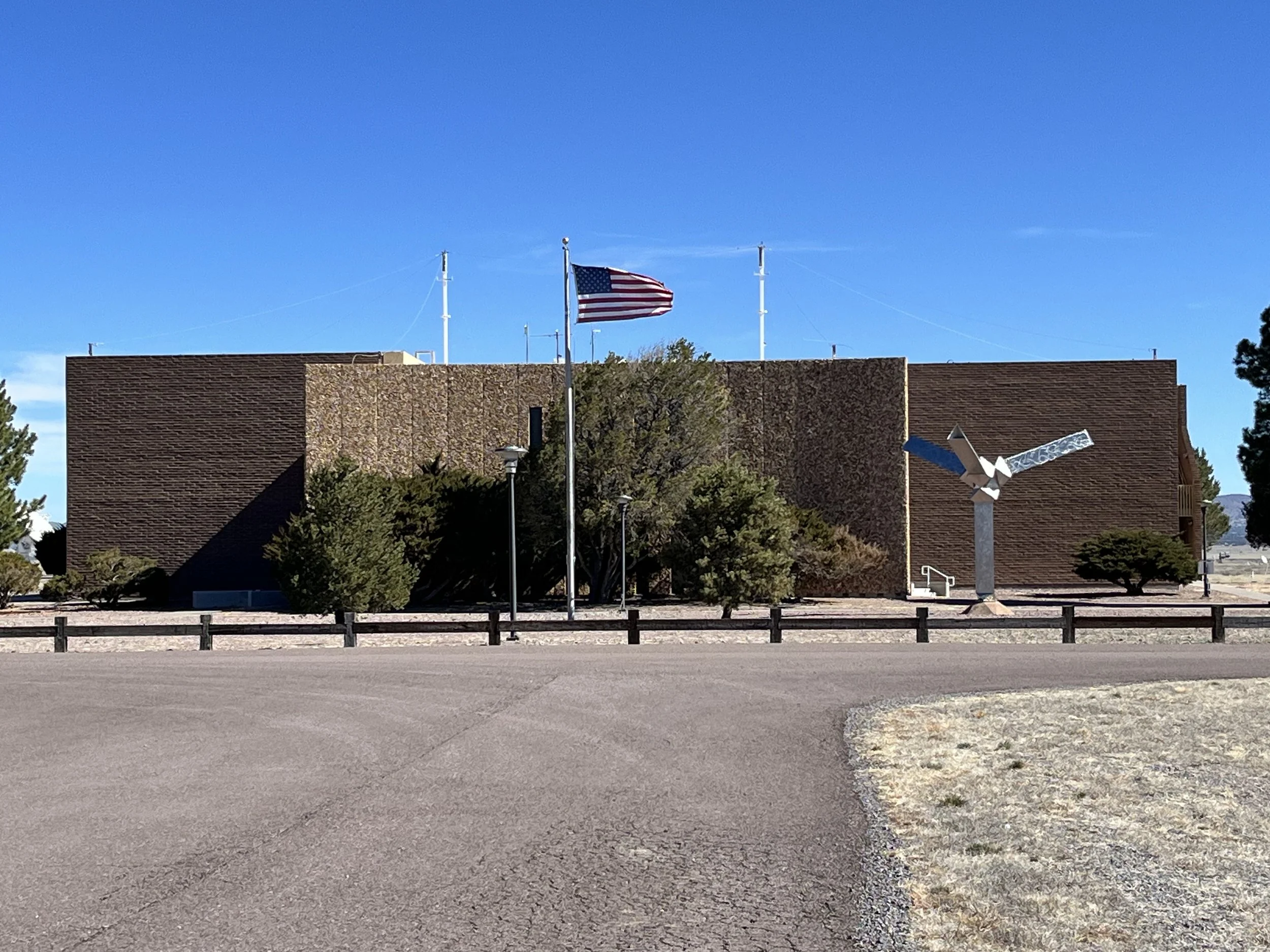
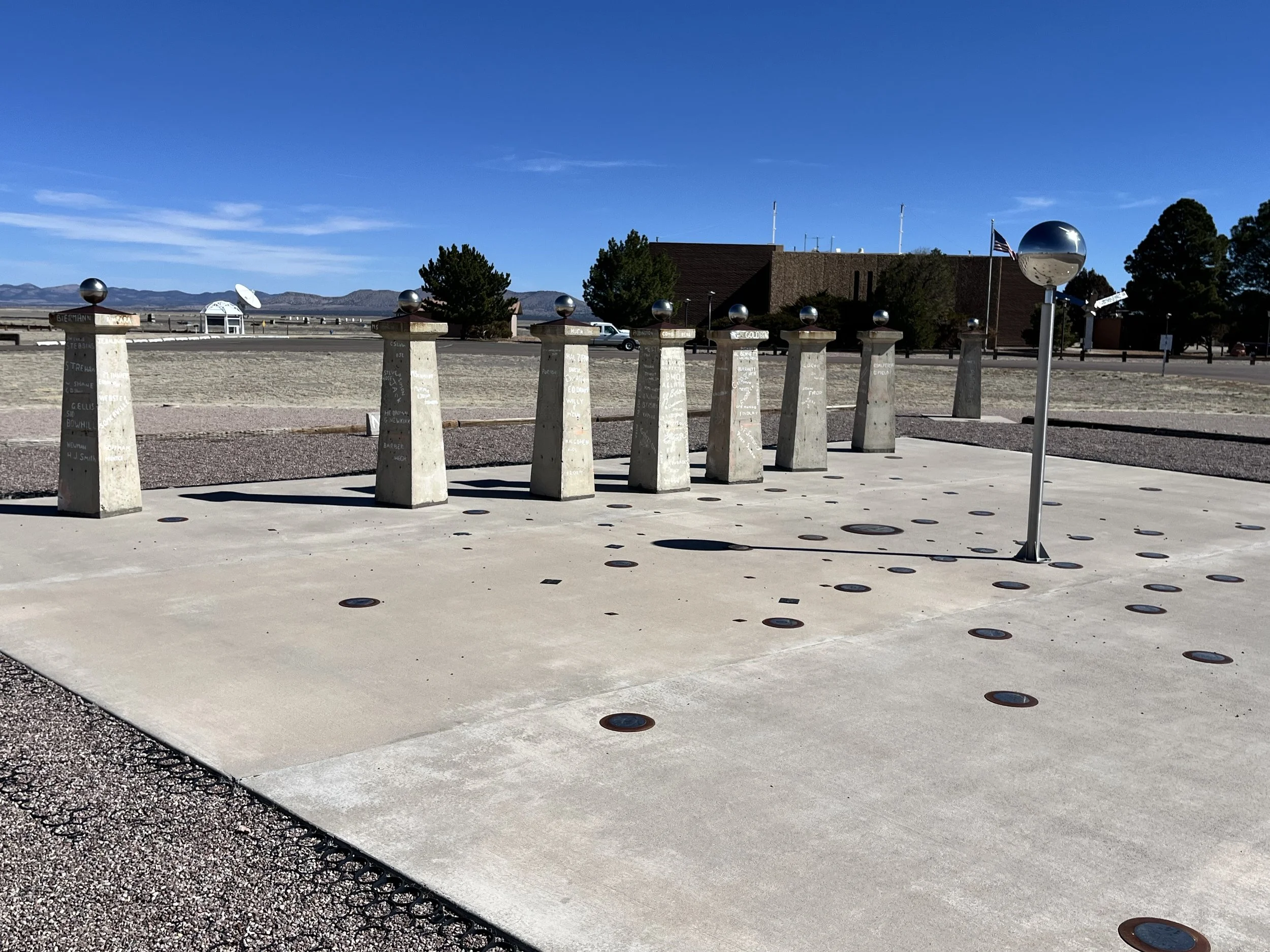
We decided to follow the turn-off for a close-up view of the VLA. The first antenna was put in place in 1975, and the facility was completed in 1980 at a total cost of US$78.5 million. The VLA is presently the largest radio telescope in the world. Surrounding the small visitor center are maintenance buildings. Signage reminds visitors to turn off cell phones and other equipment that broadcasts radio waves. Near the parking lot is Bracewell Radio Sundial where shadows that touch ground positions mark specific dates and times. The VLA has appeared in movies including Contact (1997), Terminator Salvation (2009), and Carl Sagan’s Cosmos, A Personal Voyage (1980).