
Finland. A Russian Tsar and Helsinki’s Two Cathedrals
Known for its natural and architectural beauty, Helsinki is Finland’s capital and Europe’s northernmost metropolitan area. The city’s nickname, “White City of the North” comes from its light-colored structures that can be seen when approaching from the Baltic Sea. Among its accolades, Helsinki has one of the world’s highest standards of living. However, residents living there must adjust to 19 hours of sunlight during the early summer months and the same number of hours of darkness in late December. Crossing the Baltic Sea by ferry, I disembarked at South Harbor’s waterfront. The first permanent settlement on the site of modern-day Helsinki was established by a tribe called the Tavastians in the first millennium. Later, the site was settled by Christians from Sweden who exported wood, tar, fish, and furs. A city was founded on the site in 1550 by King Gustov I of Sweden. Over its early history, Helsinki’s wooden buildings made it susceptible to damage by fire. The city also suffered from health disasters including a 1710 plague that killed a large proportion of its population. Because of its location at the tip of a peninsula, Helsinki has been called “Daughter of the Baltic” and within its boundaries are more than 330 islands including Korkeasaari, home to Finland’s largest zoo.
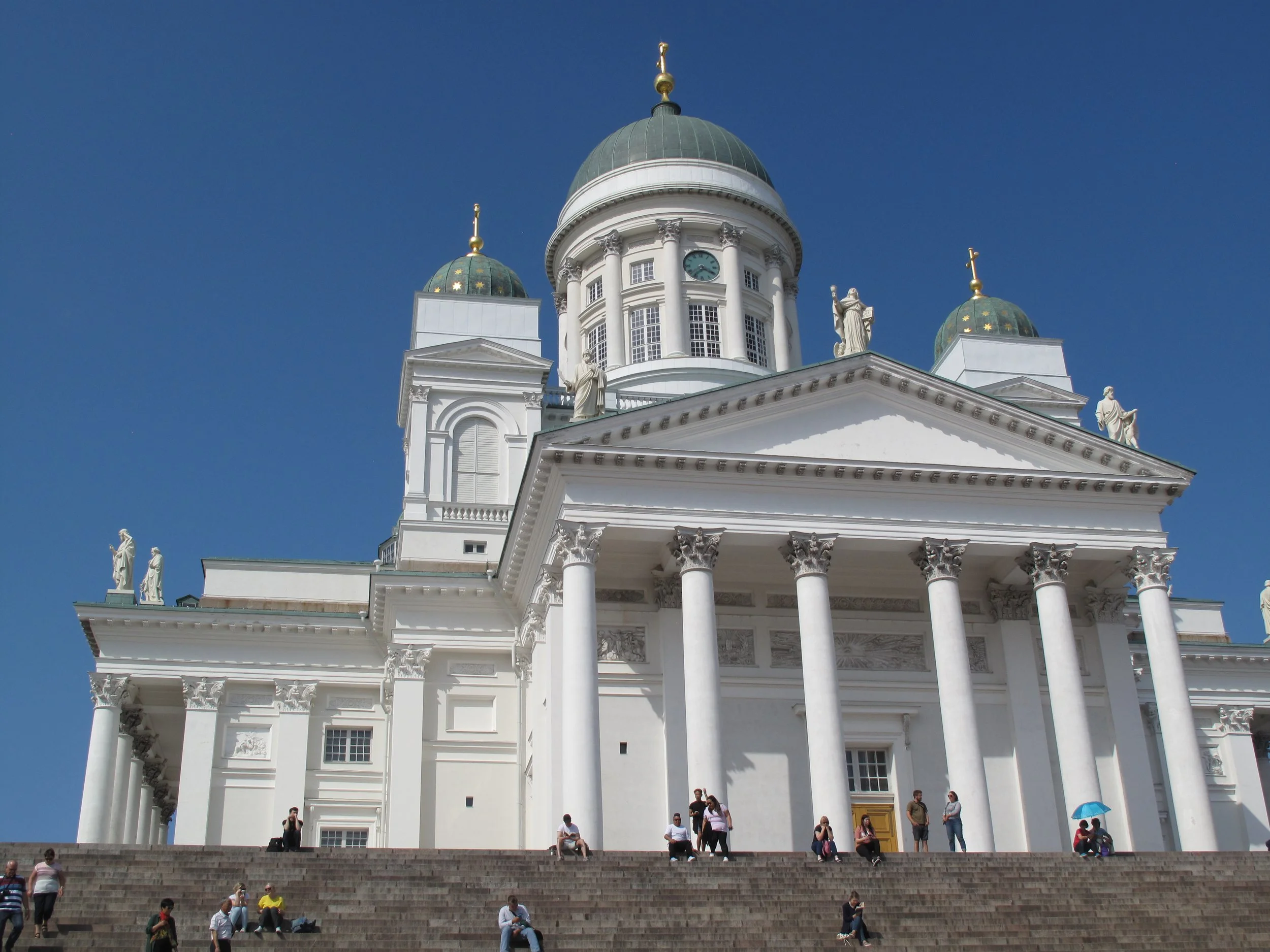
Two of Helsinki’s largest churches share a unique story. In 1812 Russian Tsar Alexander I imposed a 15% tax on imported salt to pay for the construction of two churches in Helsinki, one Lutheran and one Orthodox. My travel companions and I found Helsinki Cathedral (aka St. Nicholas Church) in the city’s Kruununhaka neighborhood. Part of the Finnish Evangelical Lutheran Church, the cathedral was completed in 1852 during the reign of Tsar Nicholas I. Designed by Johan Albrecht Ehsenström in the Neoclassical style, the church is arranged in the shape of a cross with symmetrical arms that feature colonnades topped by triangular pediments. On its top is a tall green dome surrounded by four smaller domes and on exterior walls are pilasters depicting scenes from the life of Jesus.
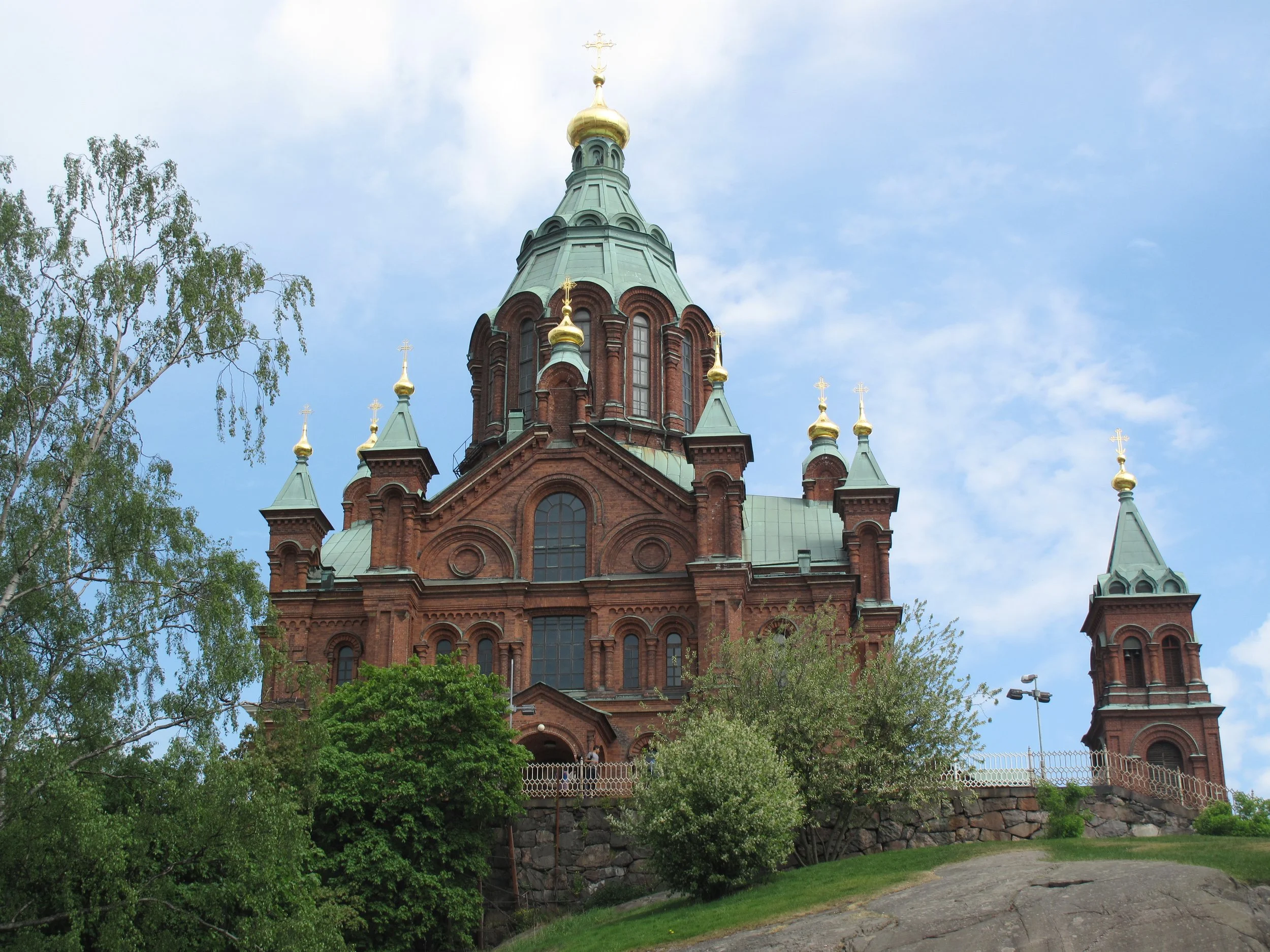
Tsar Alexander I’s other church is Uspenski Cathedral, headquarters of the Orthodox Church of Finland and the largest Orthodox church in Northern and Western Europe. Designed by Aleksey Gornostayer and completed in 1868, it is located on a hillside positioned on the Katajanokka Peninsula. The structure is designed in the Russian Revivalist Style with 700,000 bricks that were brought from Bomarsund, a military fortress on the ÅIand Islands that was destroyed during the Crimean War. The church has 13 onion-shaped domes that symbolize Christ and the Twelve Apostles. The largest is 33 meters high and topped by a gilded orthodox cross.
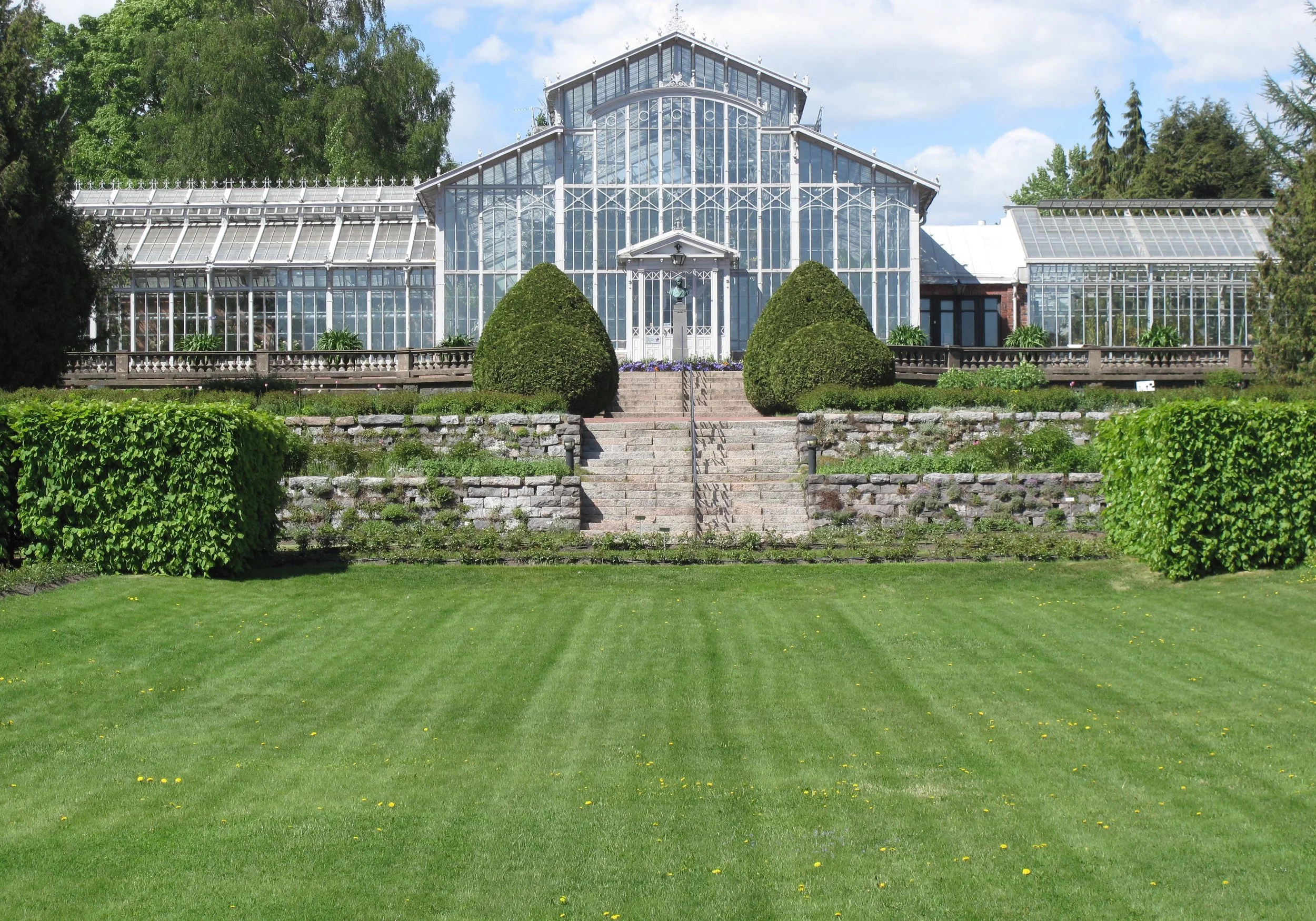
Wintergarden Talvipuutasha is a greenhouse containing more than 200 varieties of plants such as palmettos, hyacinths, daffodils, azalea, poinsettia, as several types of cacti. Designed by Gustaf Nystrōm, the conservatory opened in 1893 with three rooms: the West Wing, Cactus Room, and Palms Room. Outside is a garden with 3,000 roses planted to form geometric shapes. Inside the Palms Room is a French balcony with tables and chairs and a fishpond.
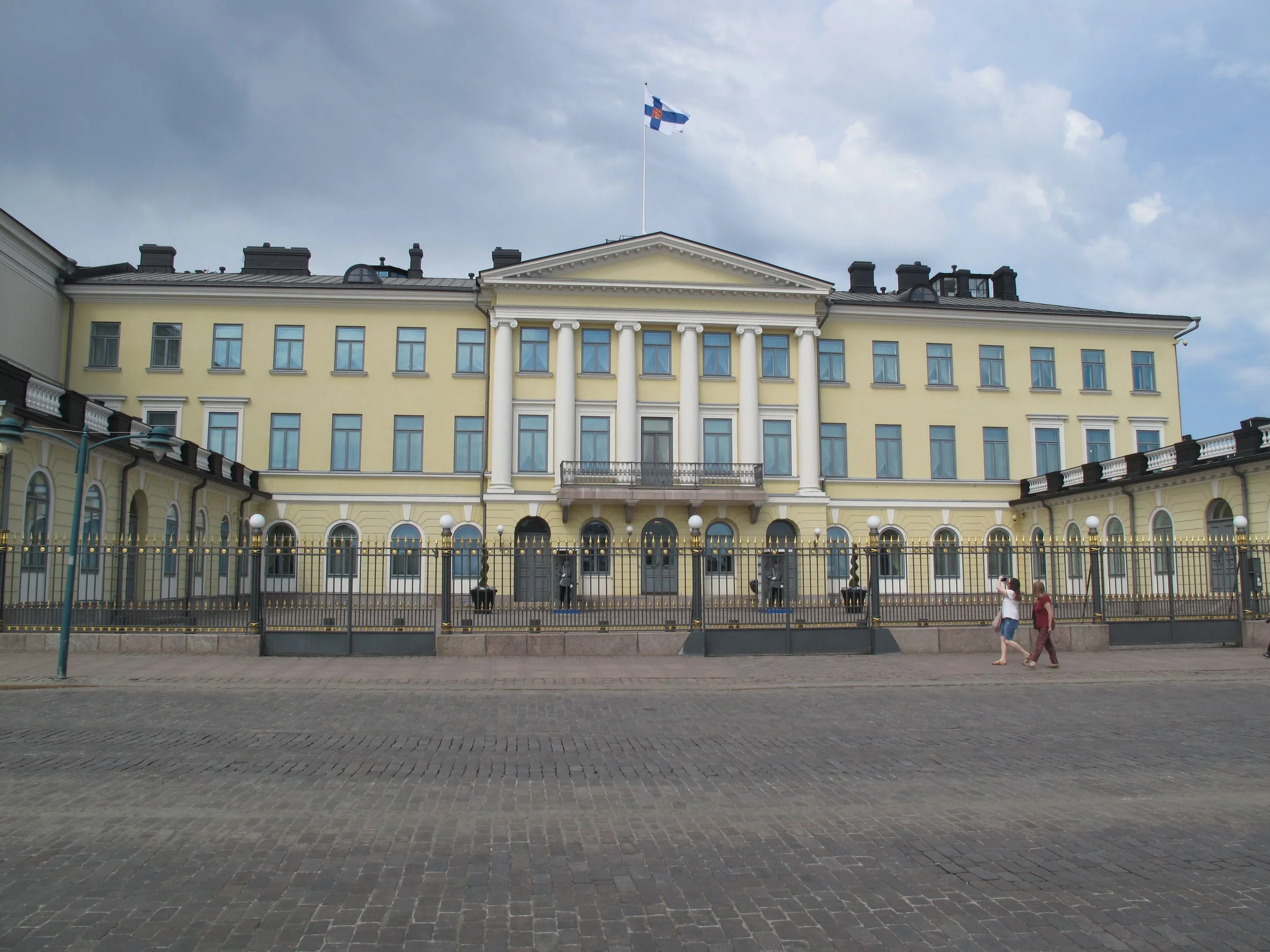
Government Palace was originally called the House of the Senate. It was constructed as a symbol of the newly established Grand Duchy of Finland following the Finnish War (1808-09) between Sweden and Russia. When Sweden ceded Finland to Russia, the country became an autonomous grand duchy where Swedish laws remained in place. From 1822 to 1918 the palace housed the Finnish government. The building is now used for the Finnish Ministry of Finance, Office of the Chancellor, and Prime Minister’s office. The palace is designed in the Empire style, a form of Neoclassical architecture that echoes Roman antiquity through columns and Pantheon-style domes. By tradition, the building’s mechanical clocks are wound manually every Wednesday.
Before departing Helsinki my travel companion and I participated in a harbor cruise. Departing from the waterfront, we motored past several islands including Klippan, located just outside South Harbor. Perched at the top of Klippan Island is a Jugend-style (a Central European type of Art Nouveau) wood pavilion constructed in 1898. With white walls and a red roof, the building was being used as a restaurant when I visited in 2018.
