
Russia. Moscow’s Opulent Underground Palaces
Carrying more than 2.7 billion riders every year, Moscow’s metro stations serve the larger region including the cities of Reutov, Kotelniki, and Krasnogorsk. A local legend tells of a diagram with proposed metro station locations being shown to Joseph Stalin. Placing his coffee cup on the map, Stalin drew a circle around its base to denote a “circle line” that would connect stations outside the city center. Moscow’s metro system opened in 1935 with eleven kilometers of track and thirteen stations. In a few years it grew to become one of the Soviet Union’s largest architectural projects with builders sparing no expense in creating “underground palaces.” Today, the system has more than 300 stations and 526 kilometers of track, making it the longest in Europe and the second-longest metro line in the world after Shanghai. The line’s official name is “Moscow Order of Lenin and Order of the Red Banner of Labor V.I. Lenin Metro.” The state-owned system is arranged as a single spoke with tracks extending radially from the city center. The system’s trains used 1,520-millimeter wide “Russian gauge” track. Today, the average distance between stations is about 1.7 kilometers. Most locals who travel on the metro pay with a Troika, a contactless and reusable smart card.
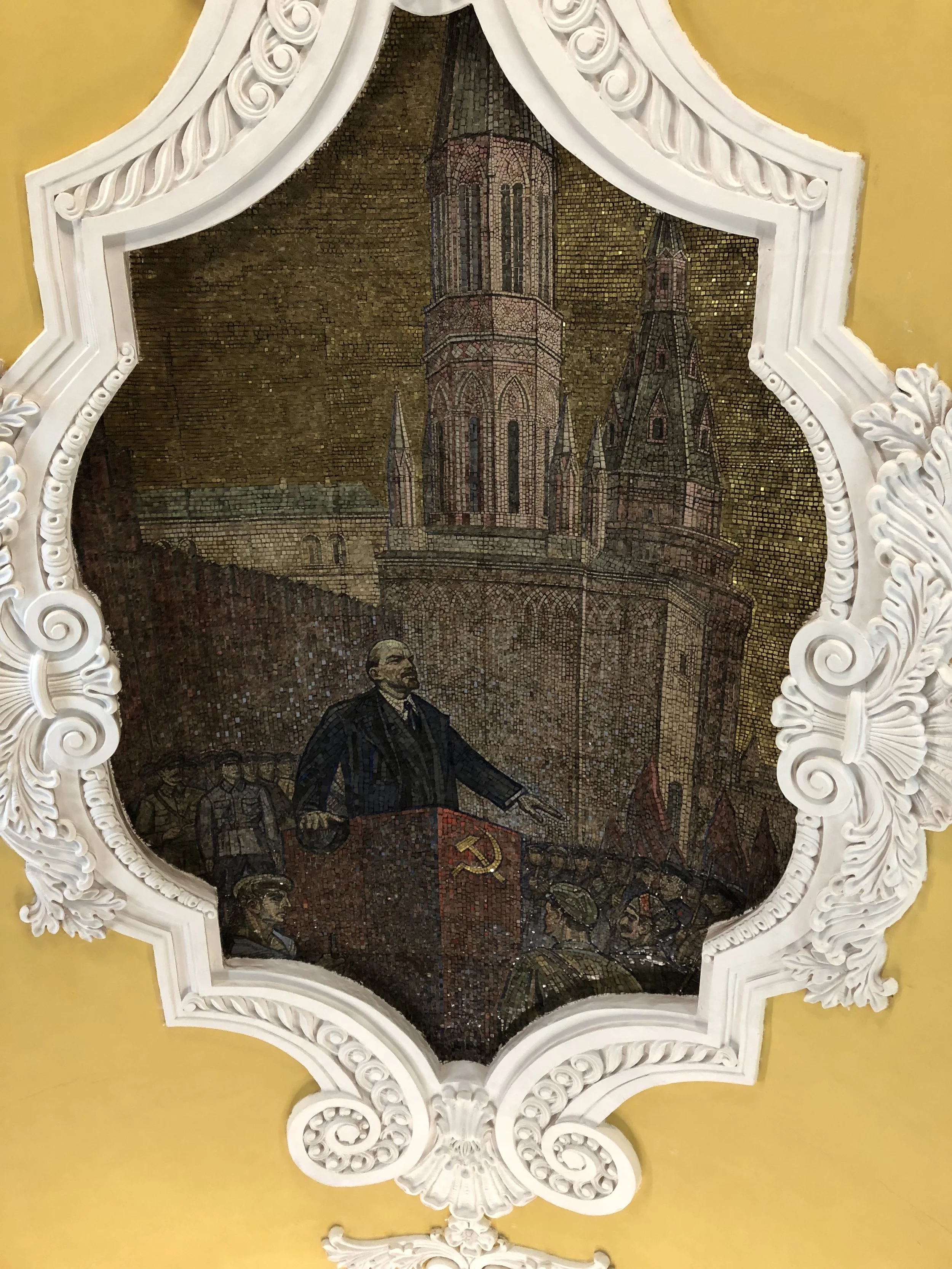
Positioned on the Koltsevaya Line, Komsomolskaya Station is located under a square with the same name. Opening in 1952, it was dedicated to the Soviet labor force and the fight for freedom and independence. The station was designed with large open spaces and heavy concrete pylons covered with marble. Paintings depict persons mentioned in a speech by Joseph Stalin in November 1941 including Dmitry Donskoy, the first prince of Moscow, and Alexander Nevsky, a prince who defeated invading Swedish armies in the 13th century. The station’s Baroque ceiling has chandeliers and yellow friezes while the fight for freedom and independence is depicted in eight ceiling mosaics created by Pavel Korin.
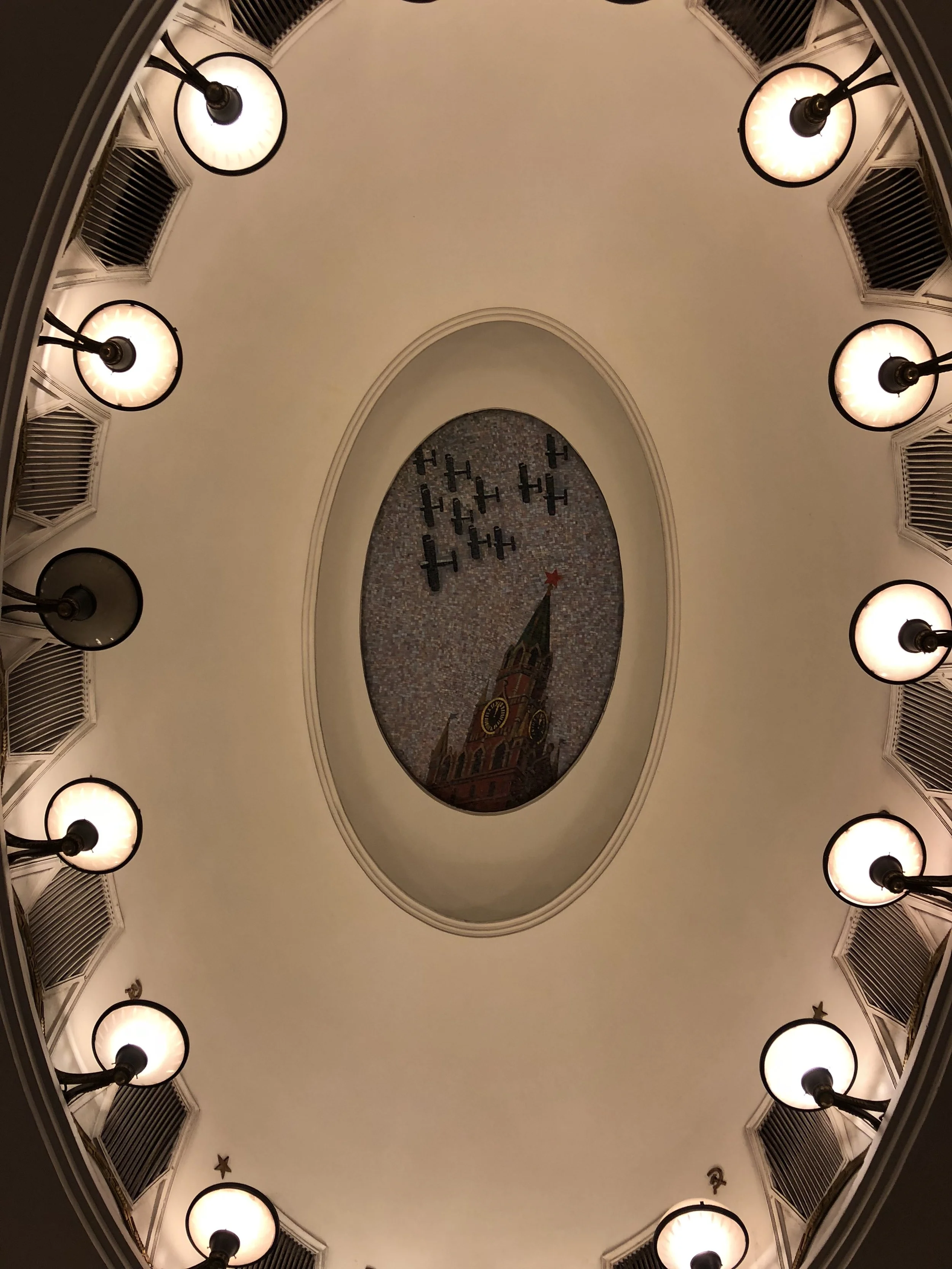
With Art Deco-style stainless steel columns and a white and pink tiled floor, Mayakovskaya Station was planned with a Stalinist design intended to represent modernism. It is located in the Tverskoy District of central Moscow and positioned thirty-three meters underground. The station has wide domes and rounded arches that frame several niches. Thirty-four ceiling mosaics depict life in the Soviet Union including one that shows aircraft flying high above Red Square. Each is illuminated by filament lights. Opening in 1938, the station was used as a command post for Moscow’s anti-aircraft regiment during WWII.
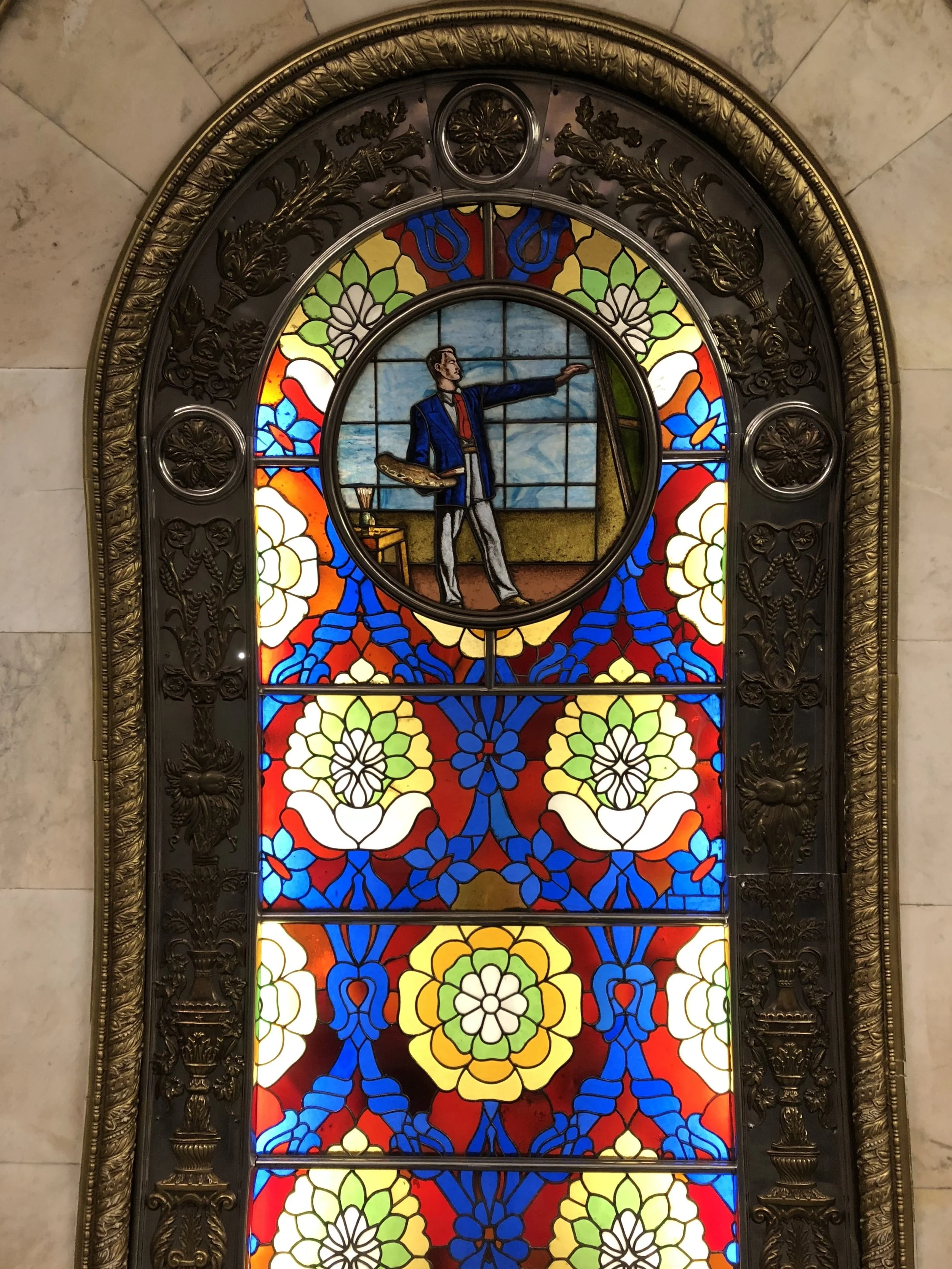
Established in November 1943, Novokuznetskaya Station honors men and women who fought in the Soviet military. Designed by Ivan Taranov and Nadezhda Bykova, it has octagonal ceiling mosaics depicting wartime industries and bas-reliefs arranged at the base of ceilings representing Red Army soldiers. Among themes presented in mosaics are the achievements of pilots, automobile manufacturers, steelworkers, and gardeners. Stained-glass panels representing ancient Russian cities make the station look like a church.
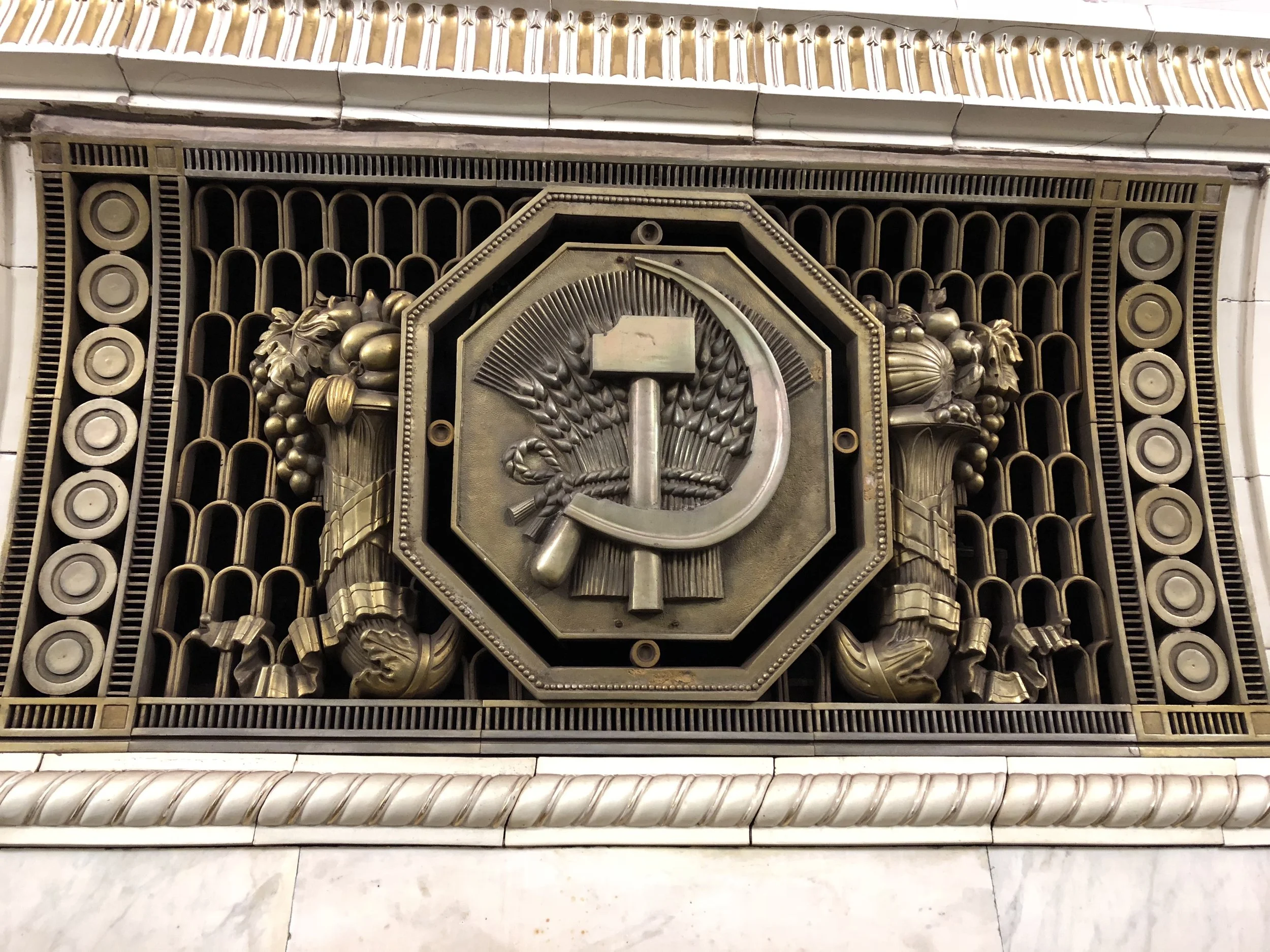
Prospekt Mira Station is located near the Botanical Gardens and Moscow State University and has a ground-level entrance inside a residential building. Designed by Mikhail Minkus and Vladimir Gelfreykh, the station opened in 1952 with a chessboard floor pattern of gray and black granite tiles and walls covered with red marble. Chandeliers are interspersed among white marble pylons while bas-relief figures represent stages in the development of agriculture within the Soviet Union. I stopped to photograph a hammer and sickle positioned at the top of one column.

Opening in 1938, Belorusskaya Station was designed by Ivan Taranov and Nadezhda Bykova. Elaborate light fixtures, ceilings, and support columns are represented in the Belarusian style. The station has ornate plaster ceilings with scroll-shaped fixtures and a sculpture called “Belarusian Partisans.” Like other stations, Belorusskaya was used as an air raid shelter during WWII. Park Pobedy (meaning “victory park”) Station opened in 2003 and serves the Arbatsko-Pokrovskaya Line. At eighty-four meters below the surface, it is the deepest station in Moscow’s metro system. From ground level we rode the 126-meter escalator (the longest in Europe) down to the track level. It takes about three minutes to reach the bottom or top. Bright green lighting at each end of the escalator warns riders to be prepared to disembark. More than 50,000 persons use the escalator every day. The station’s support columns are finished in red and gray marble. One of the station’s two large halls is dedicated to WWII veterans while the other remembers Russia’s 1812 struggle with Napoleon’s armies.
