Norway. A Walking Tour of the Fjord City
Tough and yet welcoming, Oslo is Scandinavia’s Tigerstaden (Tiger City), a culturally diverse place of outdoor enthusiasts and coffee lovers. The country’s capital and largest city (717,000 people), Oslo is located in southeastern Norway. The city’s position at the mouth of Oslofjord has contributed to its nickname, the “Fjord City.” Oslo was founded by King Harald Hardråde in 1040, near the end of the country’s domination by Vikings. Just eight years later the city was designated a kaupstad (trading place). Oslo has experienced tragedies including a bubonic plague epidemic that killed half its population in 1349 and a devastating fire in 1624. Rebuilt after the fire, the city was named Christiania in honor of King Christian IV. Following its union with the adjacent city of Aker in 1948, it became Oslo.
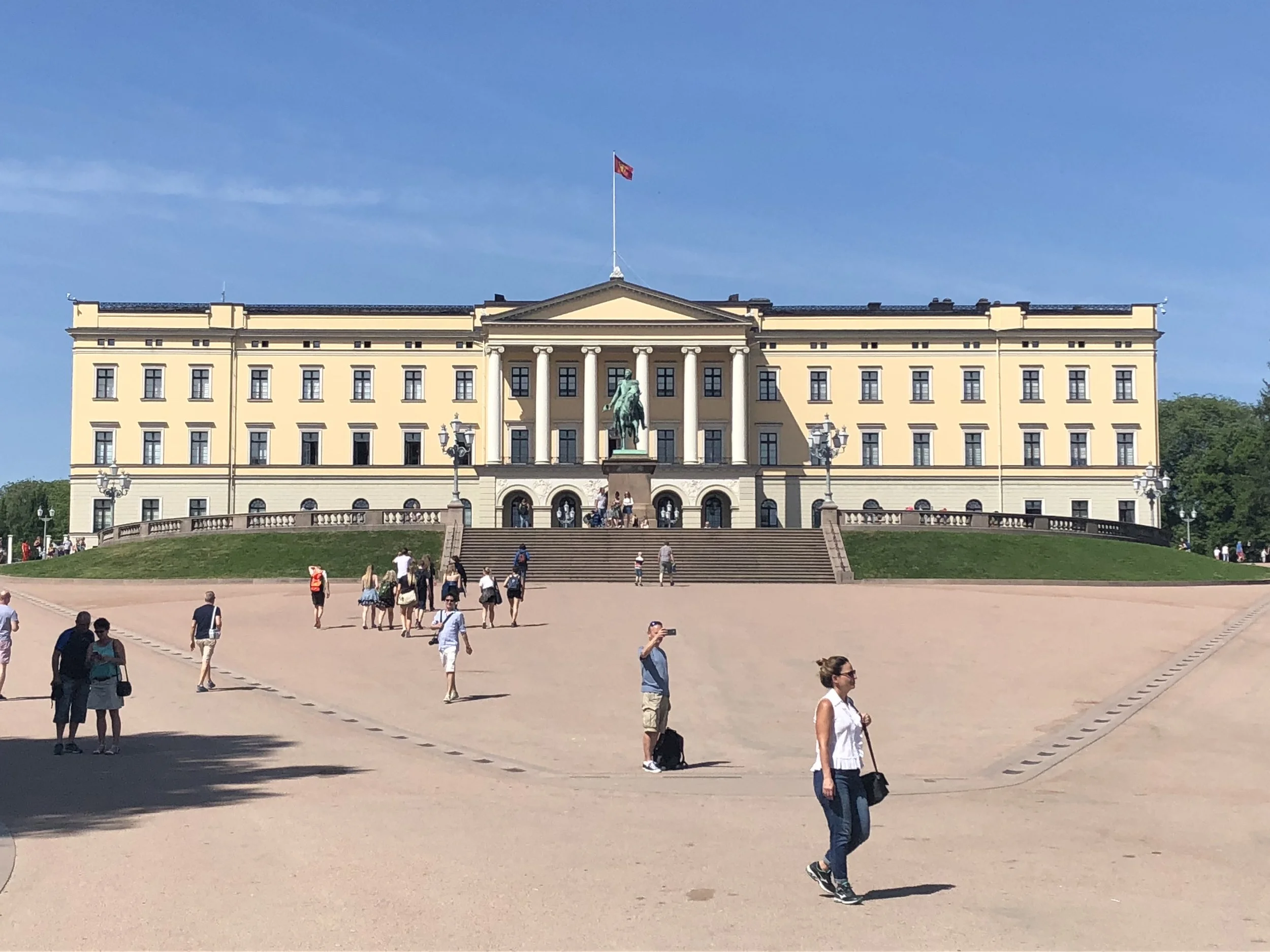
We began our walking tour near Oslo’s Royal Palace that was built during the first half of the 19th century for French-born King Charles XIV John. Having served as king of Sweden and Norway from 1818 to 1844, Charles XIV John never lived in the palace. The first royal occupants were King Oscar I and Queen Josephine. Designed by Hans Linstow in the neoclassical style, the palace was completed in 1849. Inside are vaulted ceilings, stained glass windows, and opulent decorations. The principal palace rooms include the Banquet Hall, Council Chamber (where the king met with his deputies), and the chapel. The palace is surrounded by Palace Square which features a statue of Charles XIV John on horseback, and Palace Park which was inspired by German romantic gardens that were popular in the 1840s. Today, the palace continues to serve as home to the Norwegian Royal Family. Along with its use for official functions, the palace complex is open for tours during summer months.
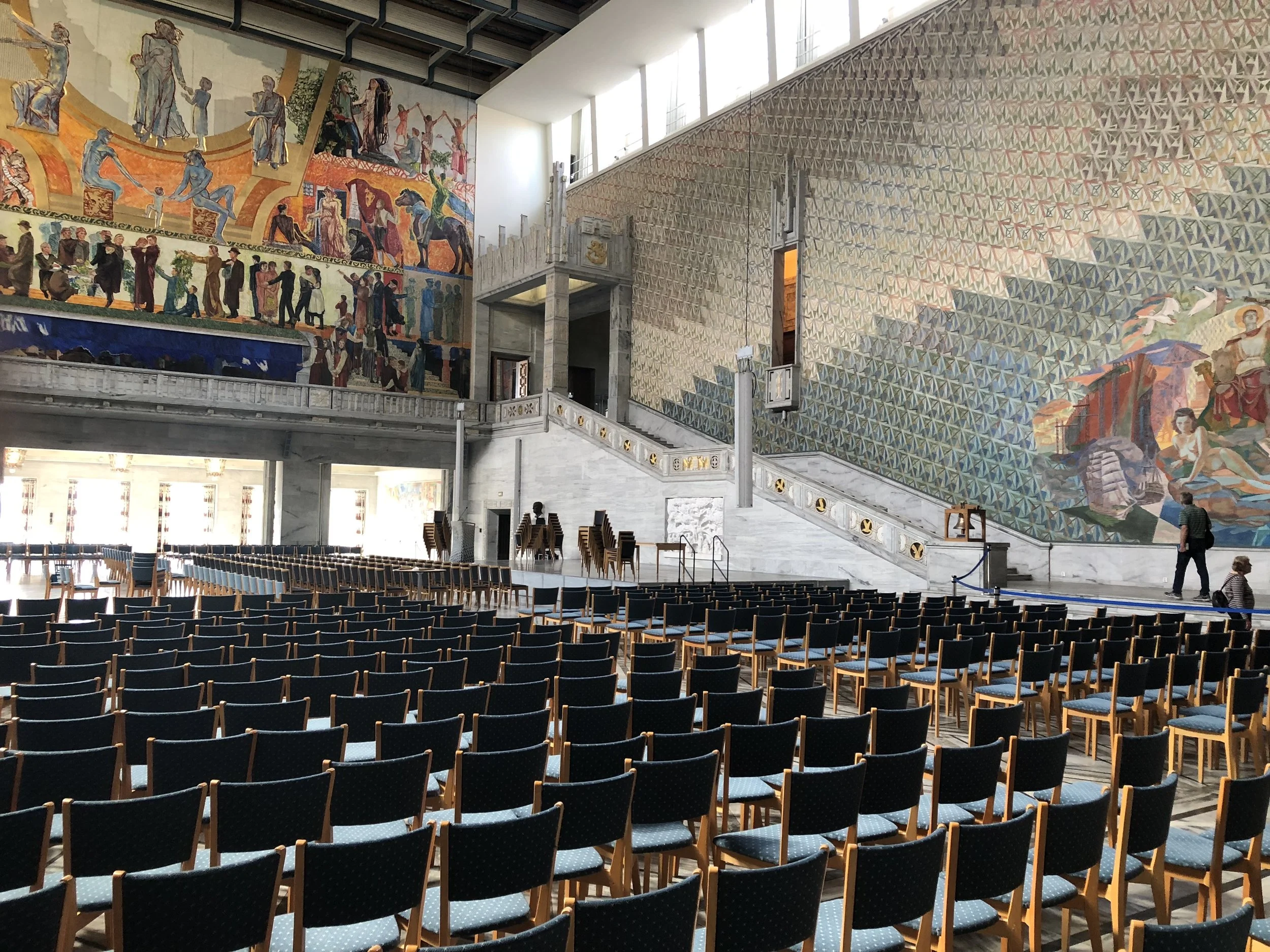
Oslo’s City Hall is called Rådhus (pronounced “road hoose” meaning “council house”). Inside is Main Hall which measures 31 meters wide by 39 meters long and seats more than a thousand persons. With marble covered walls, Main Hall is decorated with paintings that depict the city’s rich history. One frieze portrays members of the nobility working hand in hand with working class citizens. A massive oil painting represents economically disadvantaged people being employed, educated, and housed by the government. Main Hall may be best known as the venue for a ceremony held each December to honor the recipient of the Nobel Peace Prize. Dating to 1905, the event is attended by the Nobel Selection Committee, the Norwegian Royal Family, members of the Norwegian Parliament, and other dignitaries. After receiving their medal and diploma, the laureate delivers a lecture. Our walk also took us by Aker Brygge, a waterfront neighborhood constructed on the site of the former Akers Mekaniske Verksted Shipyards. With a pier and shops that sell books and clothing, Aker Brygge is also a popular location for photo shoots and concerts. Nearby, Sneak Peek is a glass tower with a 54-meter lift that offers scenic views.
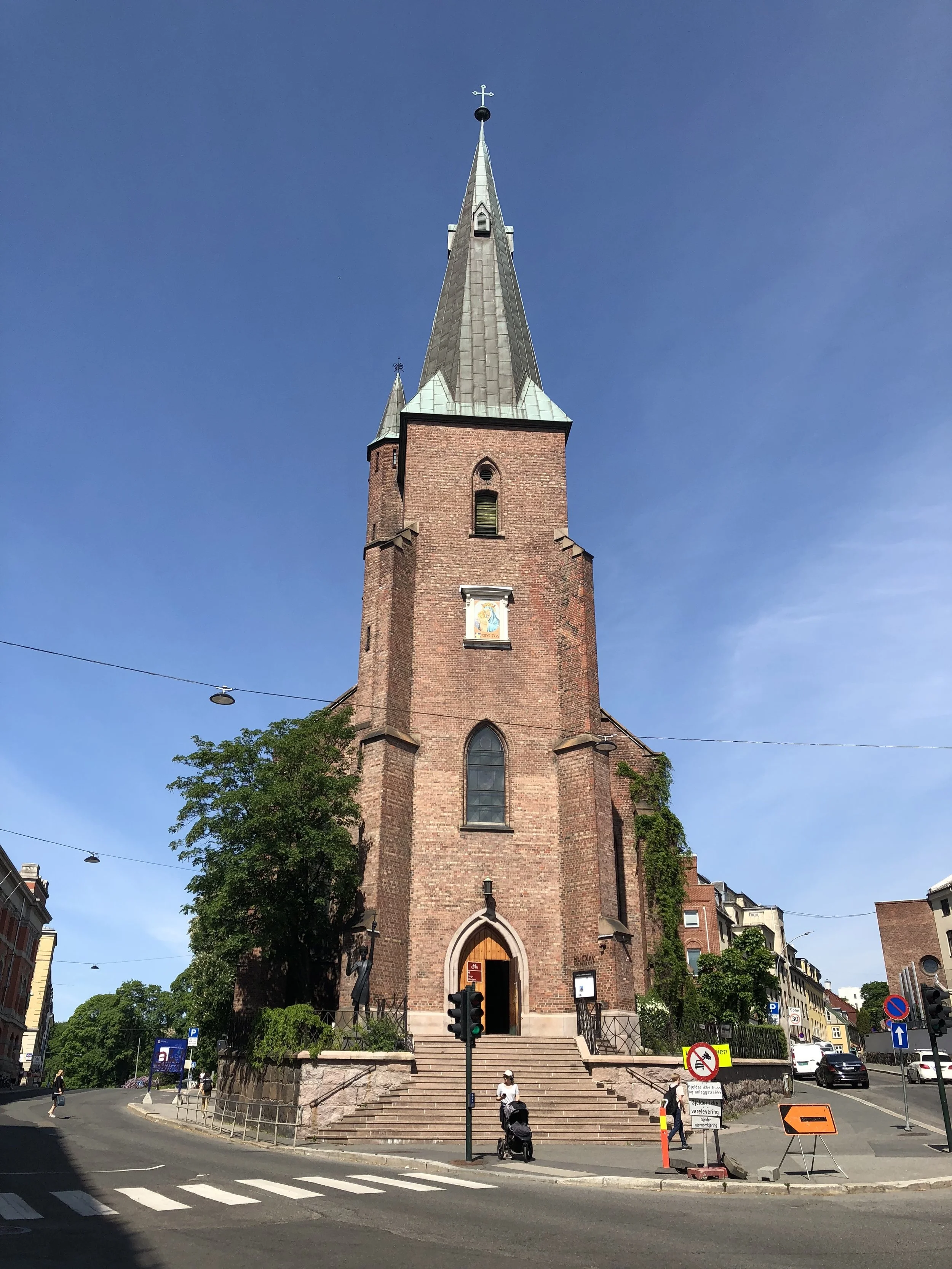
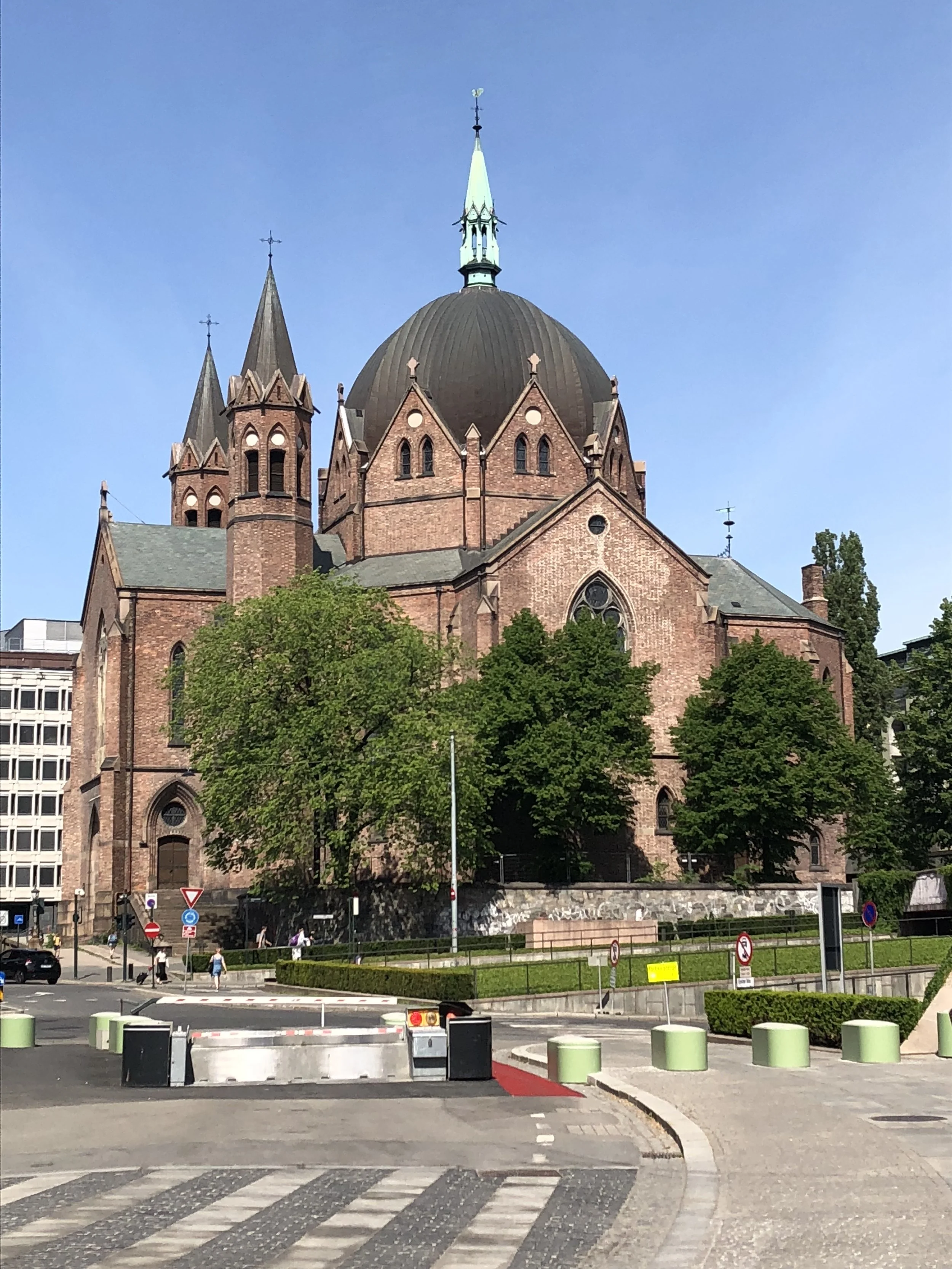
In a country where two thirds of the population is Lutheran, Catholic Church membership is relatively modest. St. Olay’s Church serves as the Catholic diocese of Oslo. Completed in 1856, St. Olay’s was the first Catholic church established in Norway after the Lutheran Reformation and was dedicated to the memory of Saint Olav (aka King Olaf II Haraldsson) who introduced Christianity to his subjects. Born in 995, Olav is said to have converted Norwegians through both persuasion and force. The church was designed by German architect Ernst Schirmer in a Neo-Gothic style. Today, St. Olay’s remains an important part of the Catholic community. In an effort to serve Oslo’s diverse population, mass is delivered in three languages: Norwegian, Polish, and Latin. Trefoldighetskirken (aka Trinity) is an Evangelical Lutheran church located at the intersection of Akersgata and Hammersborggata Streets and within the Hammersborg neighborhood of central Oslo. Constructed using red brick that forms arches, the octagon-shaped church was built under the direction of Bishop Jens Lauritz Arup. Consecrated in 1858, it has an eight-sided dome and two towers. With vaulted ceilings inside and a capacity of just over one thousand, the church is a popular venue for concerts. Today it is part of the Church of Norway with mass held every Saturday at 7:00pm.
Oslo Harbor’s 9.6-kilometer-long promenade is known as the Havnepromenaden. Along its length are parks, beaches, restaurants, and residential neighborhoods. My companion and I stopped to see Akershus Fortress (aka Akershus Festning), a medieval castle located on the banks of Oslofjord. Built as a royal residence and as protection for the city, the castle has survived sieges including a 1716 attack led by Sweden’s Charles XII. The building was occupied by Nazi forces during WWII. Inside the fortress is a mausoleum that serves as the final resting place for Norwegian royalty including King Sigurd I (1090-1130). We also had an opportunity to see the Norwegian Resistance Museum and the Armed Forces Museum that has displays dating back to Viking occupation of the city. On the far side of the inlet is Oscarshall, completed in 1852 as the royal family’s summer palace.

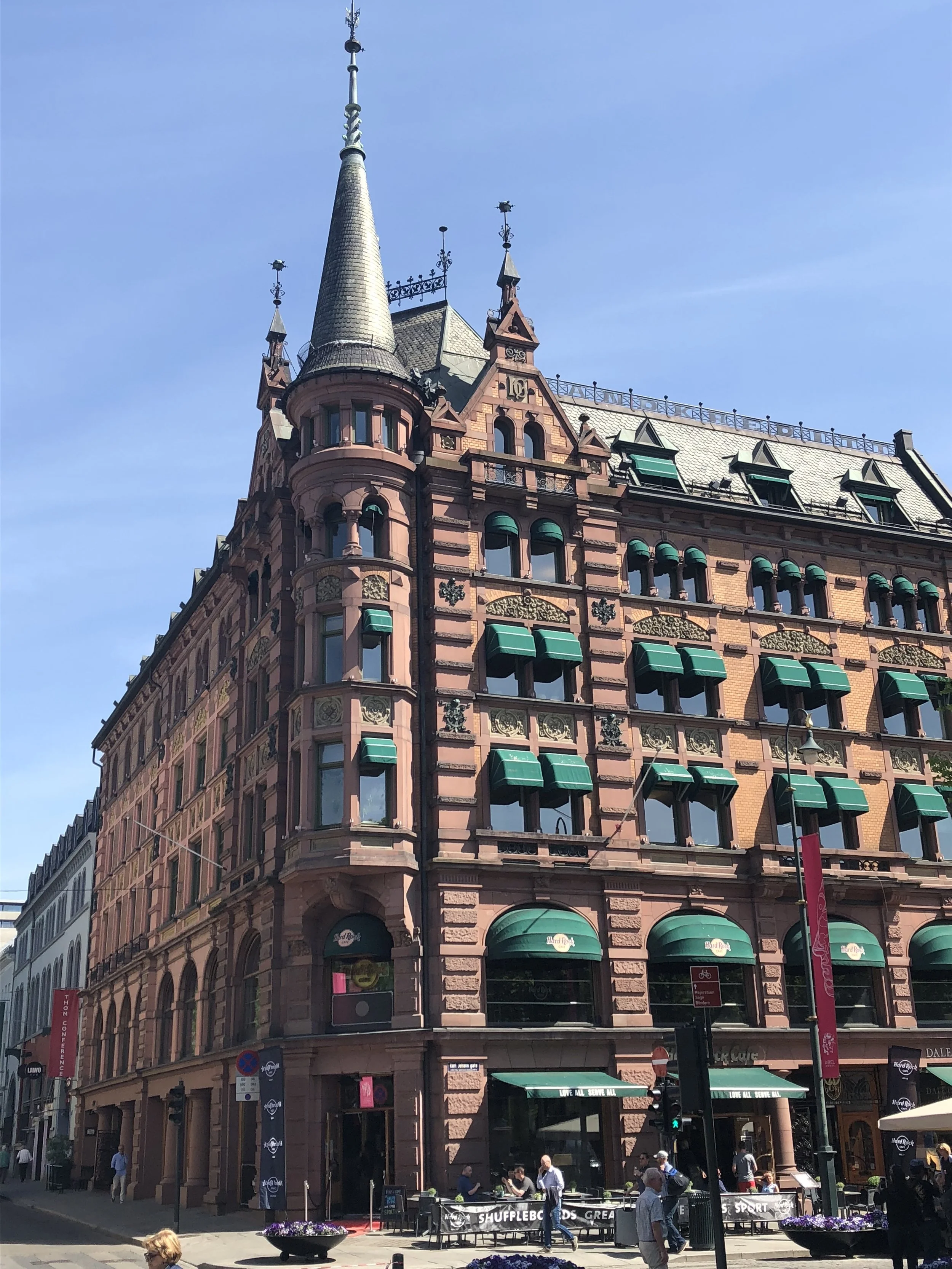
Groschgården is an ornate, Empire-style building located within central Oslo at Karl Johans Gate 45. Designed by Christian Grosch, it was built in 1897 to house Landkreditt Bank. The German-inspired building has thirty rooms and features an early elevator. Today, the Hard Rock Café occupies the building’s first floor.