Germany. Medieval Cities of the Romantic Road
My most memorable stop in Bavaria was seeing Rothenburg ob der Tauber (meaning “red castle above the Tauber”), a quaint Medieval town located in the Franconian Region and about 1.5 hours north of Munich by car. The city is on a plateau along the “Romantic Road,” a holiday route constructed in the 1950s to help Germany recover from WWII. The city’s location was first occupied by Celts in the 1st century. When Munich and Berlin were tiny settlements during the Middle Ages, Rothenburg was Germany’s second-largest city (population 6,000). A castle was constructed there in 1070, about one hundred years before the town was formally established. During the Thirty Years’ War (1618-1648), the commander of Catholic forces, Johann Tserclaes, requested that the city’s Protestant residents provide quarter for his 40,000 troops. When they refused, Tserclaes took the city by force. Allied bombing damaged about 30% of the city during WWII and in April 1945, German forces surrendered Rothenburg to avoid its destruction. Today, it is among four cities in Germany with its medieval wall (four kilometers long) still intact. Some consider Rothenburg ob der Tauber to be Germany’s best preserved walled city.
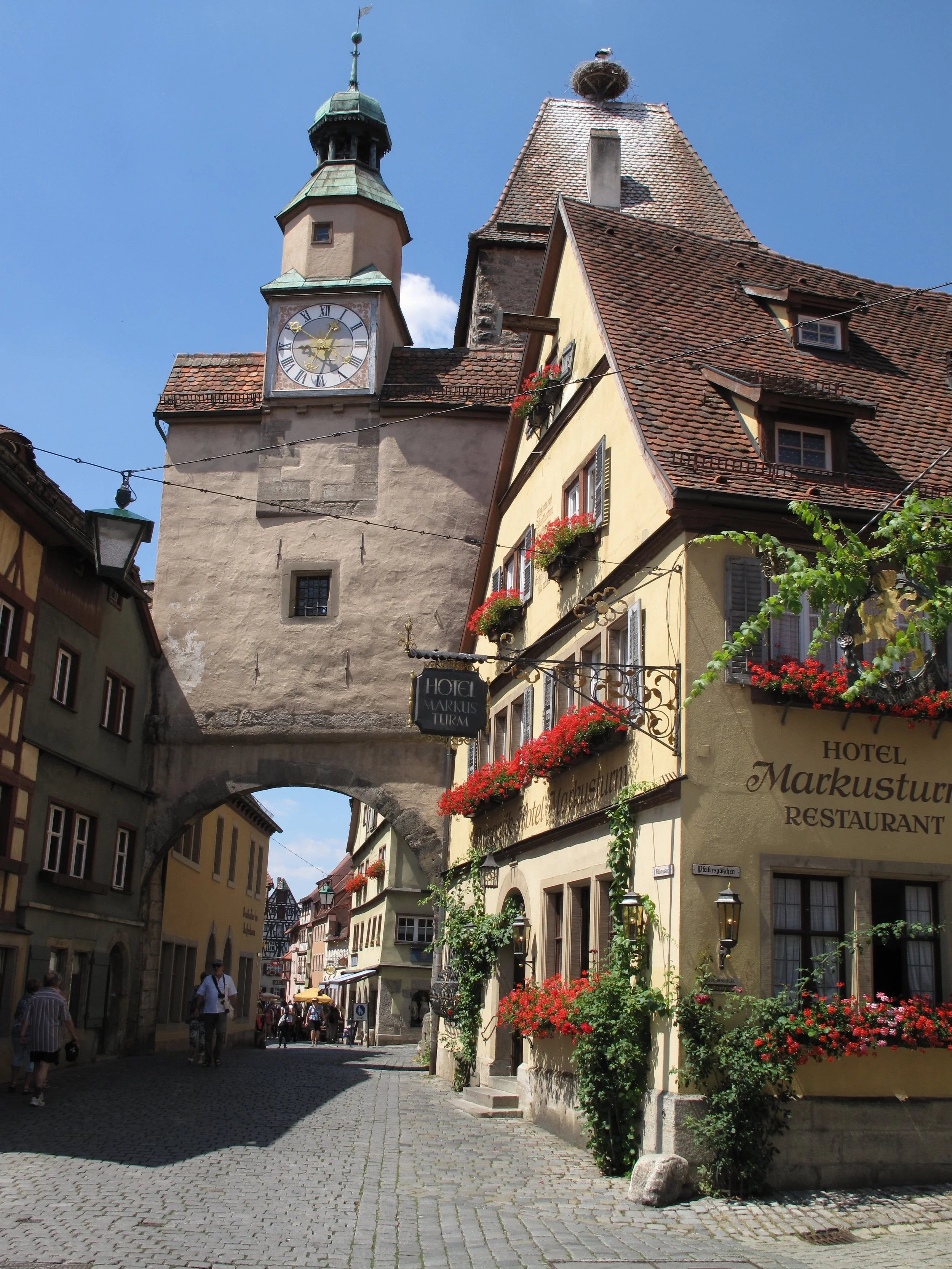
Our walking tour took us down cobblestone streets flanked by timbered houses with red roofs. Near the Romantik Hotel is Gallows Gate, a massive stone archway with towering spires, and Plönlein Street with its fairytale-like houses. The street served as a model for Walt Disney animators who created the movies Pinocchio (1940) and Beauty and the Beast (1991).
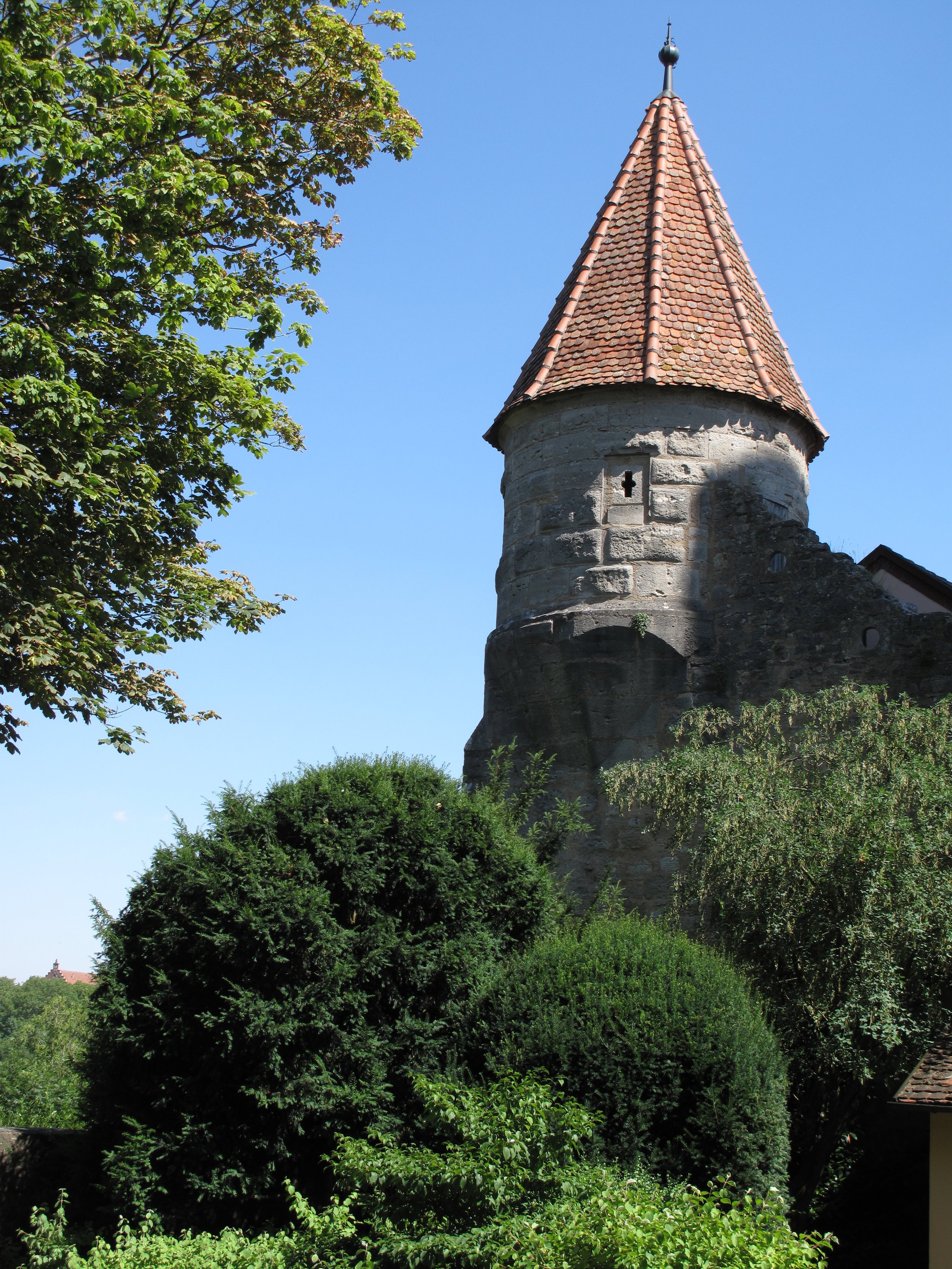
Another attractive building is Saint Jakobs Kirche (St. James Church), built between 1311 and 1485. We paused at the fountain in Plönlein Square. One of the joys of visiting Bavarian towns is sampling the food. A schneeball (snowball) is a large shortbread-like biscuit covered in sugar, cinnamon, and chocolate. Resembling a quiche, Zwiebelkuchen are onion cakes made with bacon, cream, and onions.
Located forty kilometers north of Rothenburg ob der Tauber on the Main River, the city of Würzburg was established as a Celtic stronghold and later became a fortress town within the Roman Empire. The Roman stronghold was located where Marienberg Fortress now stands. Christianity came during the late 7th century. In 1814 Würzburg became part of Bavaria. Modern industries within the city and its periphery include grape production and printing. Today, the city’s population is about 130,000.
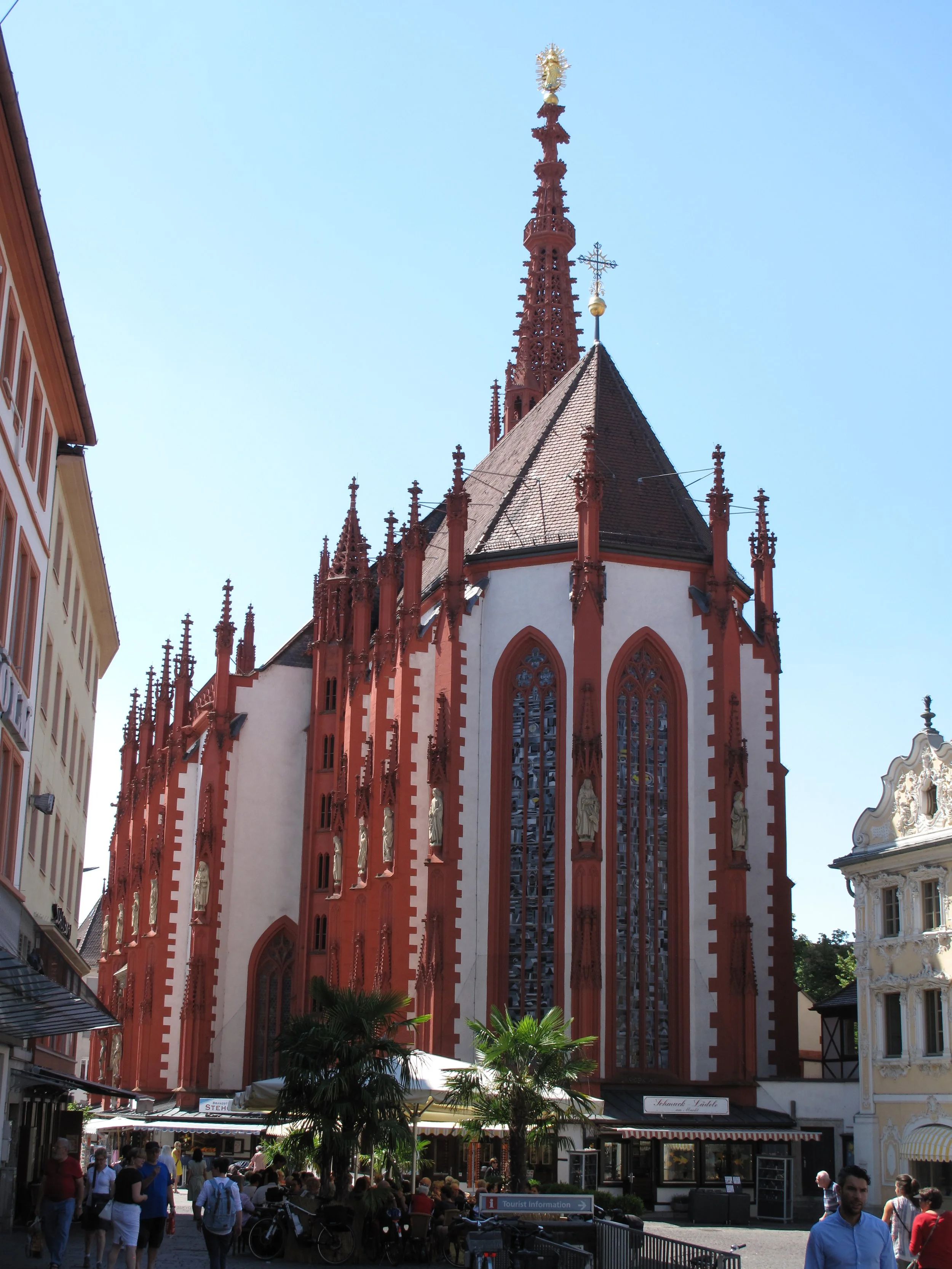
Würzburg has an infamous history. During the 17th century the city’s bishop, Philipp Adolf von Ehrenberg, took measures to eradicate heresy and consolidate power by making Würzburg the focal point for one of the most brutal witch hunts in European history. Beginning in 1626, the witch trials targeted people of all ages, sexes, and classes. In 1631 alone, more than 600 alleged witches were burned at the direction of Bishop Ehrenberg. Some were beheaded first while others were burned alive. Most of the killings took place outside Marienkapelle (St. Mary’s), a Gothic-style Roman Catholic Chapel near Unterer Markt. Outraged by the barbarism, Swedish King Gustavus Adolphus intervened to stop additional killings. The citizens of Würzburg also suffered during WWII with nearly 90% of the city destroyed by British bombers. Among severely damaged structures was Marienkapelle chapel. In April 1945, Würzburg was occupied by the U.S. 12th Armored Division.
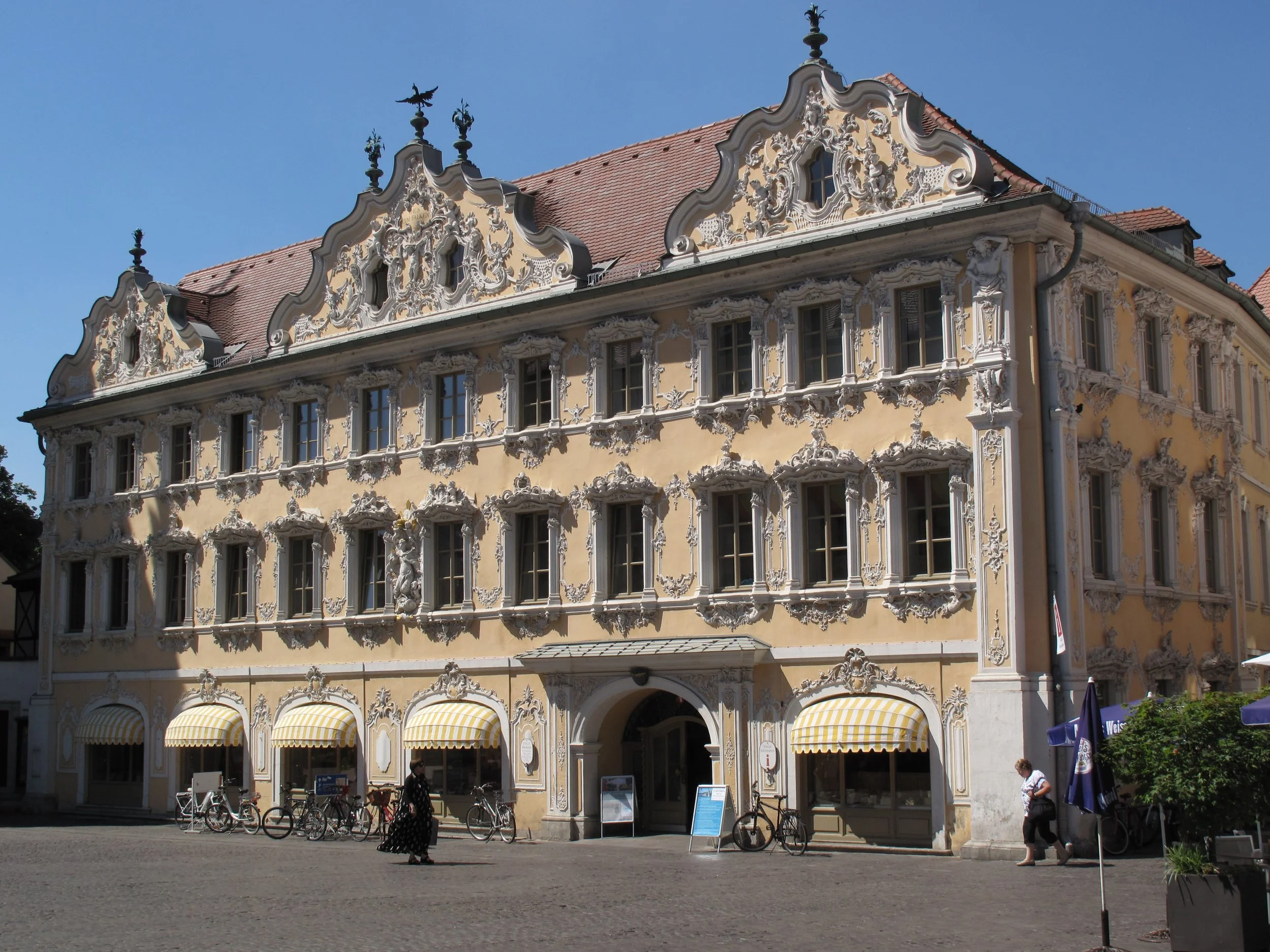
With bright colors, mascarons (ornaments featuring a face), whimsical curves, and other asymmetrical forms, Falkenhaus (the House of Falcon) is an example of Rococo façade architecture. The building is positioned on Market Square and served as the residence of the cathedral’s priest. After the 14th century, it was used as a venue for dances and concerts. Today it serves as a tourist information center and as the city’s library. In the nearby market, vendors sell fresh fruit, vegetables, and flowers. It’s also possible to purchase sausages, bratwurst, sourdough or rye bread, various cheeses, and yogurt.