Uzbekistan. Islamic Schools of Samarkand’s Registan Square: Oxford in Central Asia
With tall minarets, turquoise-blue domes, and arching portals adorned with tiled mosaics and gold leaf, the old city of Samarkand offers opportunities to see pristine examples of Timurid-era (14th and 15th century) architecture. Positioned in present-day Uzbekistan and along Central Asia’s historic silk roads, Samarkand is home to Registan Square, a plaza known for three historic madrasahs (Islamic schools): Ulugh Beg, Sherdor, and Tilakari. Operating as elite centers for higher learning, Samarkand’s madrasahs have been described as the Oxford of their time. A larger area that includes the present-day city of Samarkand has been occupied since the Paleolithic (aka Stone Age). A city called Marakanda was founded there sometime between the 8th and 7th centuries BC and later integrated into an ancient Persian civilization called the Sogdiana. Conquered by Alexander the Great in 329 BC, the city thrived under Hellenistic (Greek) rule. Armies of the Umayyad Caliphate took control of the city from the Tang (Chinese) dynasty in 710. At that time Samarkand’s populace followed a diversity of religions including Hinduism, Buddhism, Judaism, Christianity, and Zoroastrianism. Among these, the most widely followed was Zoroastrianism. After capturing the city, Qutayba ibn Muslim replaced the Zoroastrian temple with a mosque and later, much of the city’s population converted to Islam. Following the fall of the Samanids in 999, Samarkand was ruled by the Turkic Qarakhanid dynasty.

In 1220, the city was invaded by Mongol armies under Genghis Khan whose soldiers killed all persons seeking refuge in the citadel and forced 30,000 to serve in the Mongol army. Following a 1365 revolt against Mongol rule, Samarkand became part of the powerful Timurid dynasty that ruled over a region that encompassed modern Iraq, Iran, Pakistan, Afghanistan, northern India, and the southern Caucasus. Uzbek nomads took control of the city in 1500 and later, Samarkand became part of the Bukhara Khanate. When the Russians took over in 1868, they built the newer part of the present-day city. By 1888, Samarkand was widely known as a production center for cotton, fresh fruit, rice, and wine. The city was briefly (1924-36) the capital of the Uzbek Soviet Socialist Republic. Today, city residents speak Uzbek, Tajik, and/or Russian. The name “Samarkand” comes from an Iranian language called Sogdian with “samar” meaning “stone” and “kand” meaning “fort.” With a centralized layout, streets converge at Registan Square. Established in 1871, the newer, Russian section of the city has theaters, parks, and public buildings including a university founded in 1933.
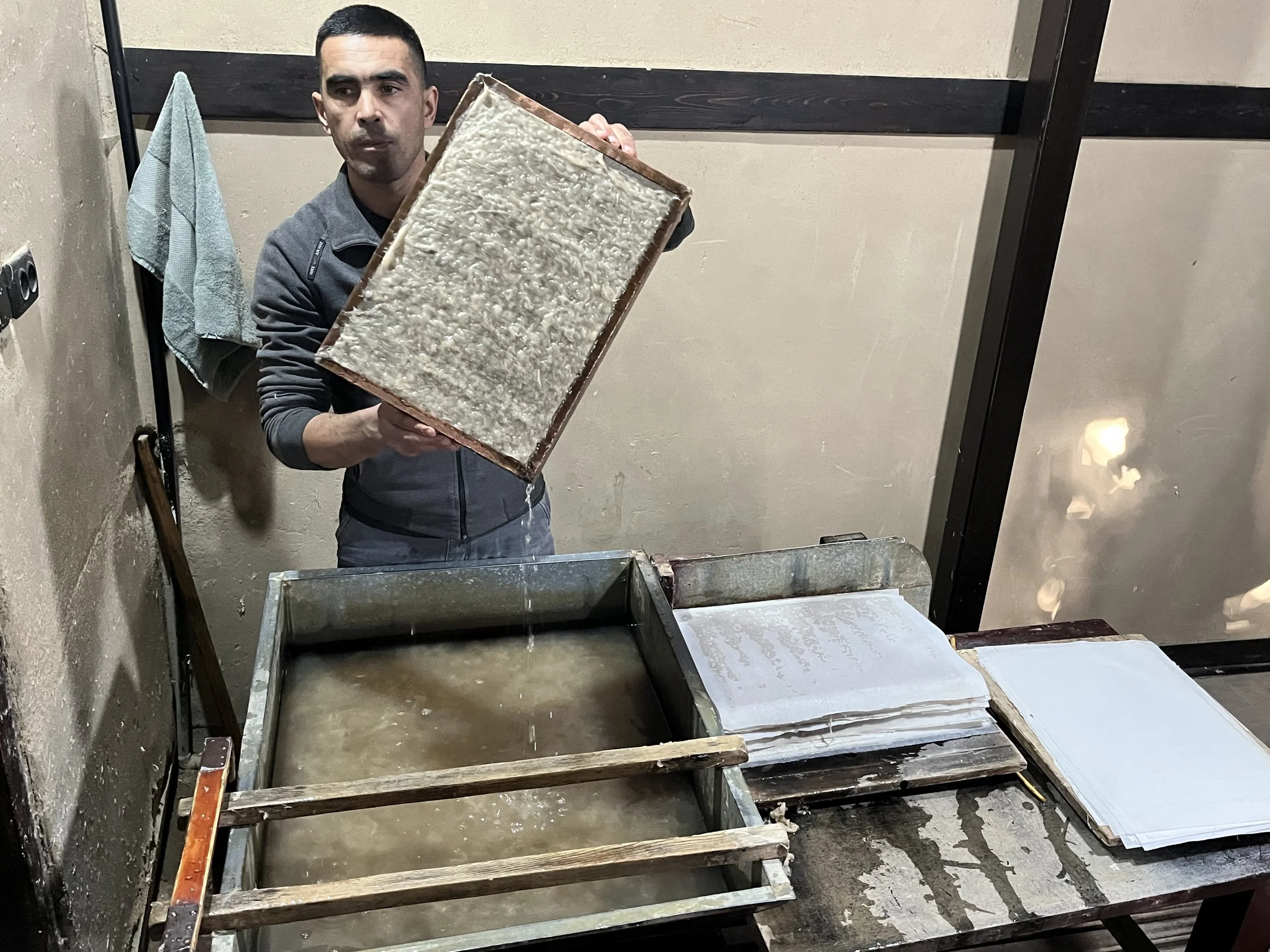
We were fortunate to visit a shop where paper is still manufactured using traditional methods. Inside workers demonstrate the extraction of fibers from mulberry branches. After being boiled in large pots the mulberry strands are pounded with mallets driven by a machine powered by running water. The pulp is then filtered through sieves, compressed under heavy stones, and polished into flat sheets. Samarkand’s paper is famous for its durability and pleasing texture.
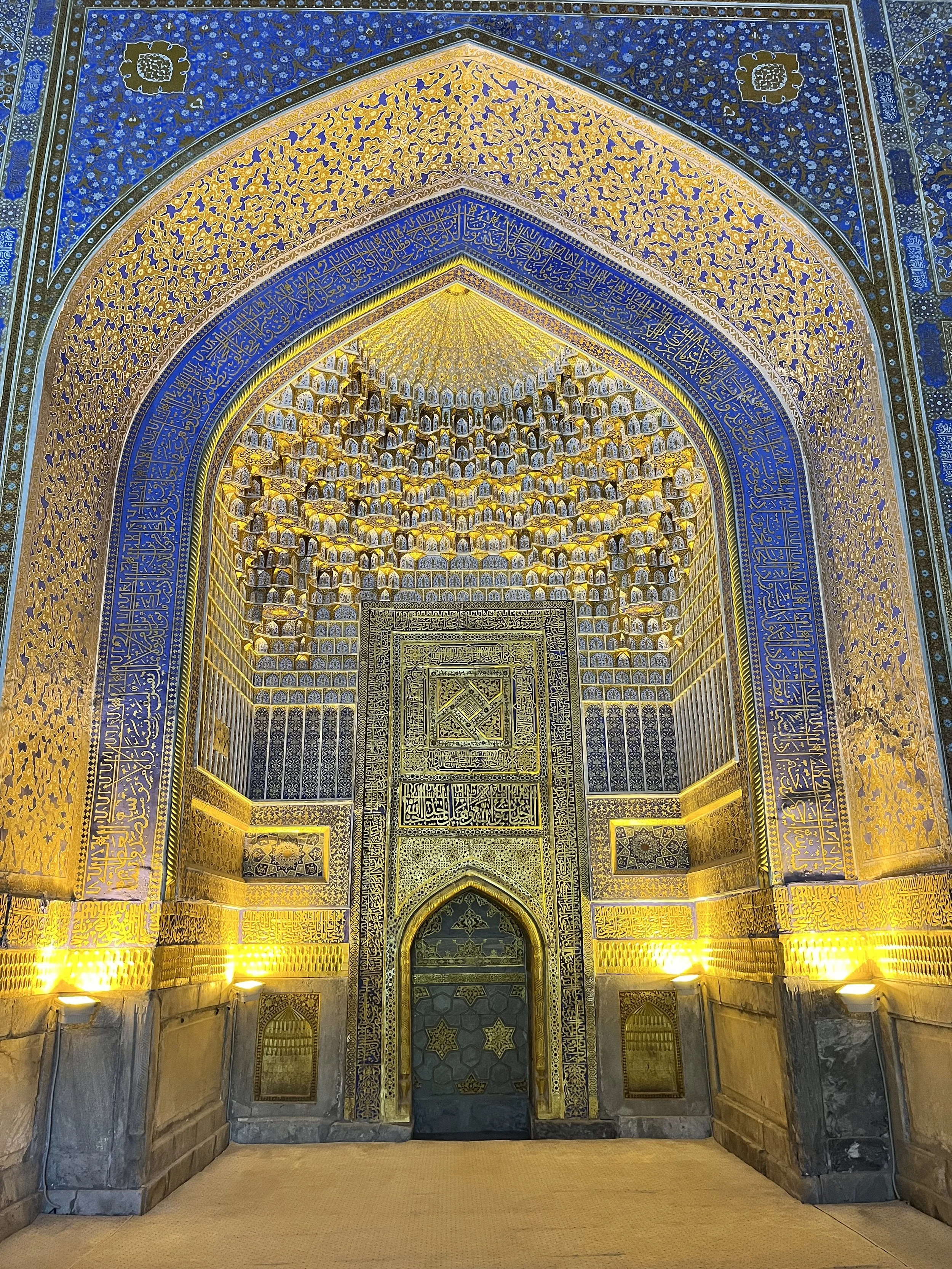
Our tour of Registan Square began at Ulugh Madrasah. Dating to the Timurid Period and completed in 1420 by Timur’s grandson, Ulugh Madrasah’s corners feature tall minarets covered with mosaics that form geometric shapes. During the 15th century Ulugh was considered among the world’s finest universities for preparing Islamic clergy. In 1924 the madrasah was repurposed to provide space for a bazaar. Recognizing its historic importance, the structure was restored by the Soviets in stages between 1932 and 1987. Completed in 1636 under the direction of Yalangtush Bahadur, Sherdor Madrasah operated during the Janid period (1599-1785). Another structure from the Janid period is Tilakari Madrasah, completed in 1660. The youngest of the three madrasahs, its name translates to “decorated with gold.” The section of its façade facing Registan Square is symmetrical with a high portal and two floors featuring arched niches. Within its walls is an inner courtyard with student study cells called hujras.
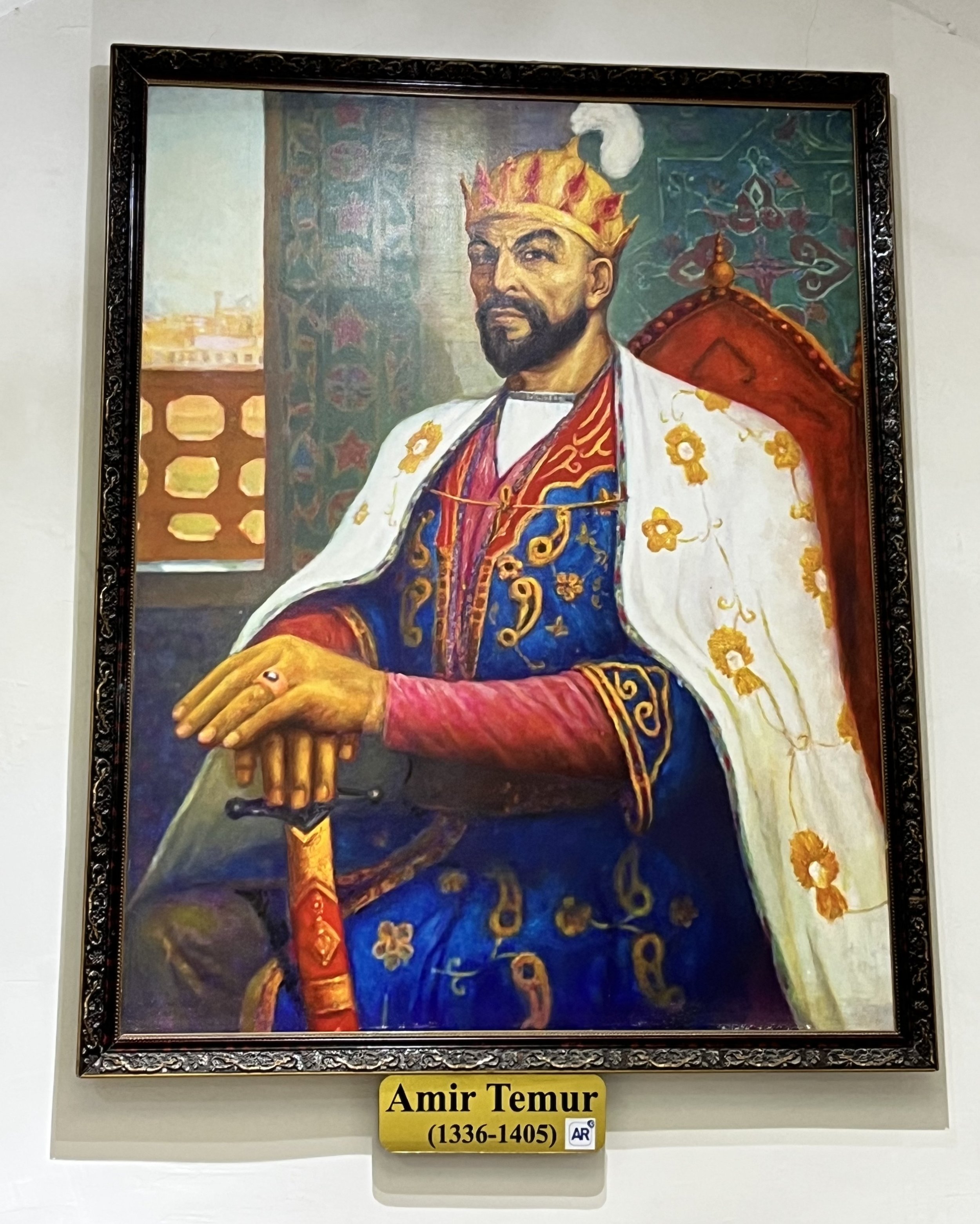
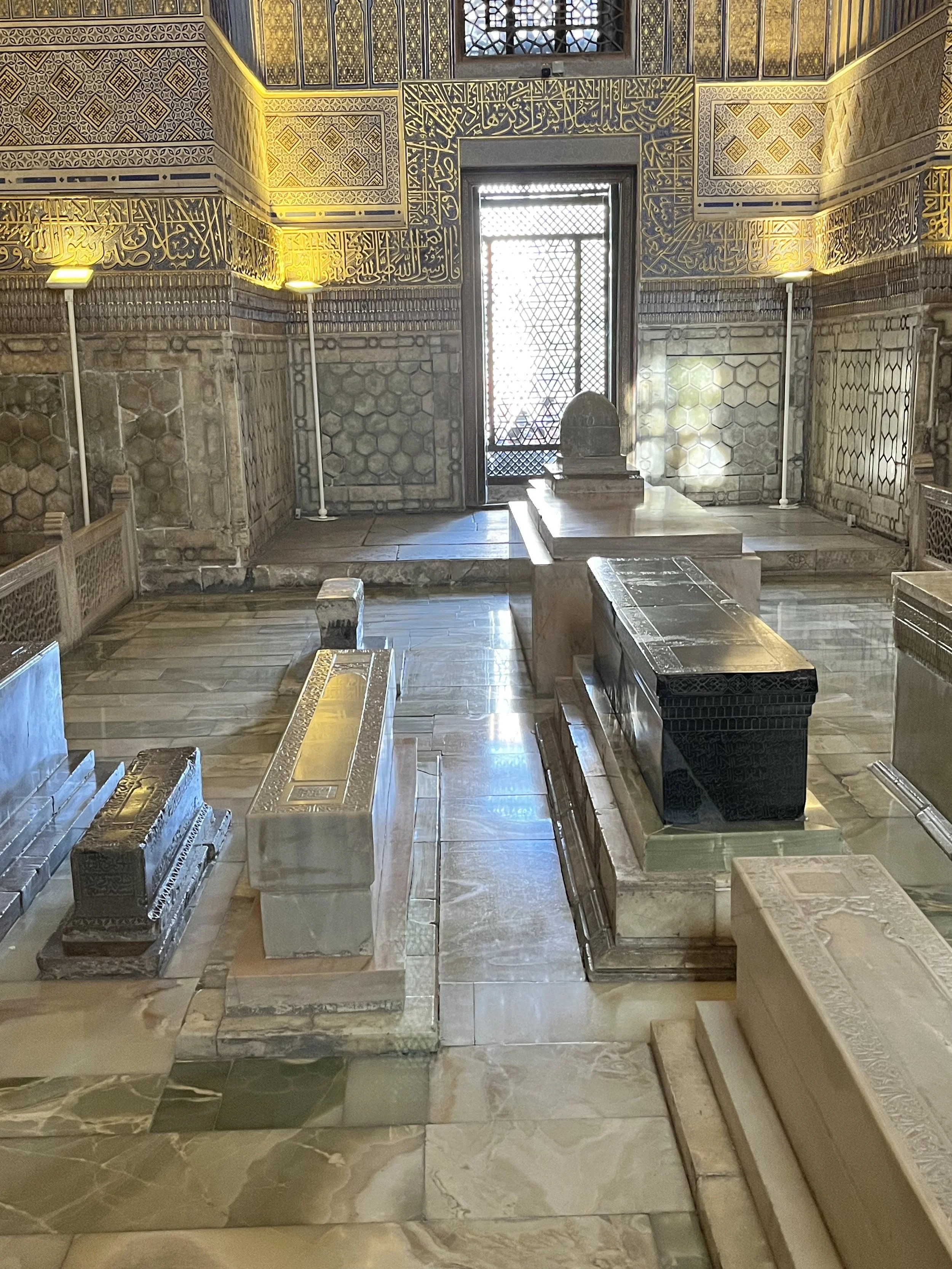
Gur-e-Amir is a mausoleum built for Timur and his family and located south of Registan Square along Bostonsaroy Street. In Persian, the name “gur-e-amir” means “tomb of the king.” Along with serving as the burial place of Timur, the building houses the tombs of Timur’s two sons, two grandsons, and his teacher, Sayyid Baraka who was believed to be a descendant of the prophet Mohammad. Construction of the tomb was started in 1403 following the death of Muhammad Sultan, Timur’s grandson and heir. Famous for its simplicity, the building is octagonal shaped and topped by a 15-meter-tall dome. Venturing inside, we could see cenotaphs (rectangular markers) that recognized people entombed in the building. The cenotaphs are not meant to mark the location of remains since the bodies of Timur, his family, and Sayyid Baraka are in underground crypts below the mausoleum. Timur’s cenotaph is a single block of dark green jade.
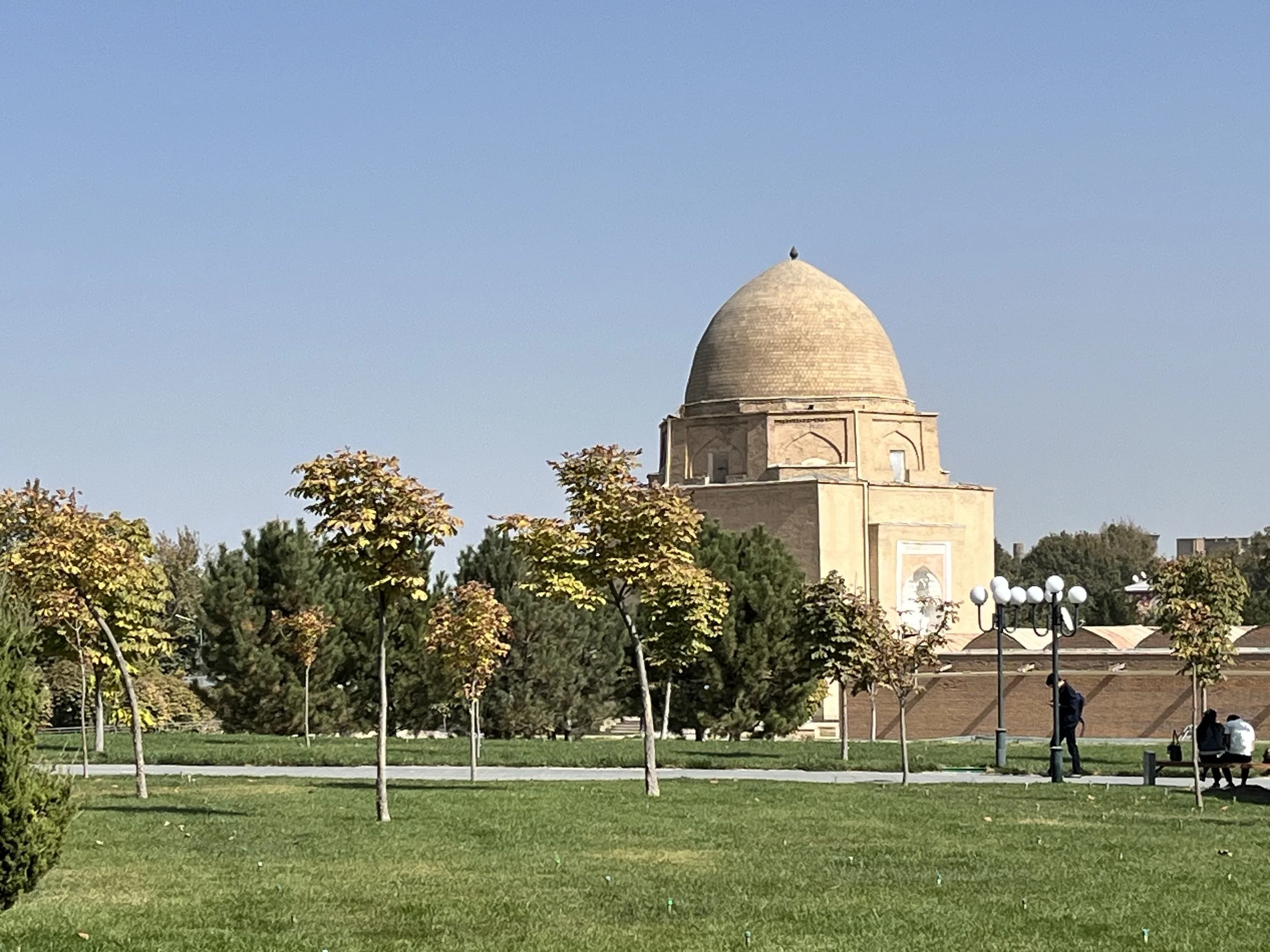
Our walking tour took us past Rukhobod Mausoleum, one of the city’s oldest buildings. The mausoleum was constructed as the final resting place for Sheikh Burhan al-Din Sagarji, a well-known 14th century Sufi theologian. A propagator of Islam within Xinjiang, China, Sagarji became a member of the Chinese emperor’s court. From a distance, the building looks like a large (12m x 14m) cube topped with a (12m) domed roof. Sagarji’s wife and nine children are also buried there.