
Uzbekistan. City of Mosques, Madrasahs, and Minarets
Bukhara is a vibrant city located on the famous “silk roads” between Europe and Asia. Along with serving as a center for trade, Bukhara was a focal point for Persian culture and scholarship and by 850, capital of the Samanid Empire. Armies of Genghis Khan laid siege to the city for 15 days in 1220. Beginning in the 16th century, the city’s importance declined and by the 19th century, Bukhara was ruled by local emirs. Falling under Russian domination in the late 19th century, the city was capital of the Bukhara People’s Soviet Republic between 1920 and 1924. Subsequently it was incorporated into the Uzbek Soviet Socialist Republic. Bukhara is known for its libraries and as a center for scholarship. I was excited for an opportunity to explore this attractive city of mosques, madrasahs (schools), and minarets.
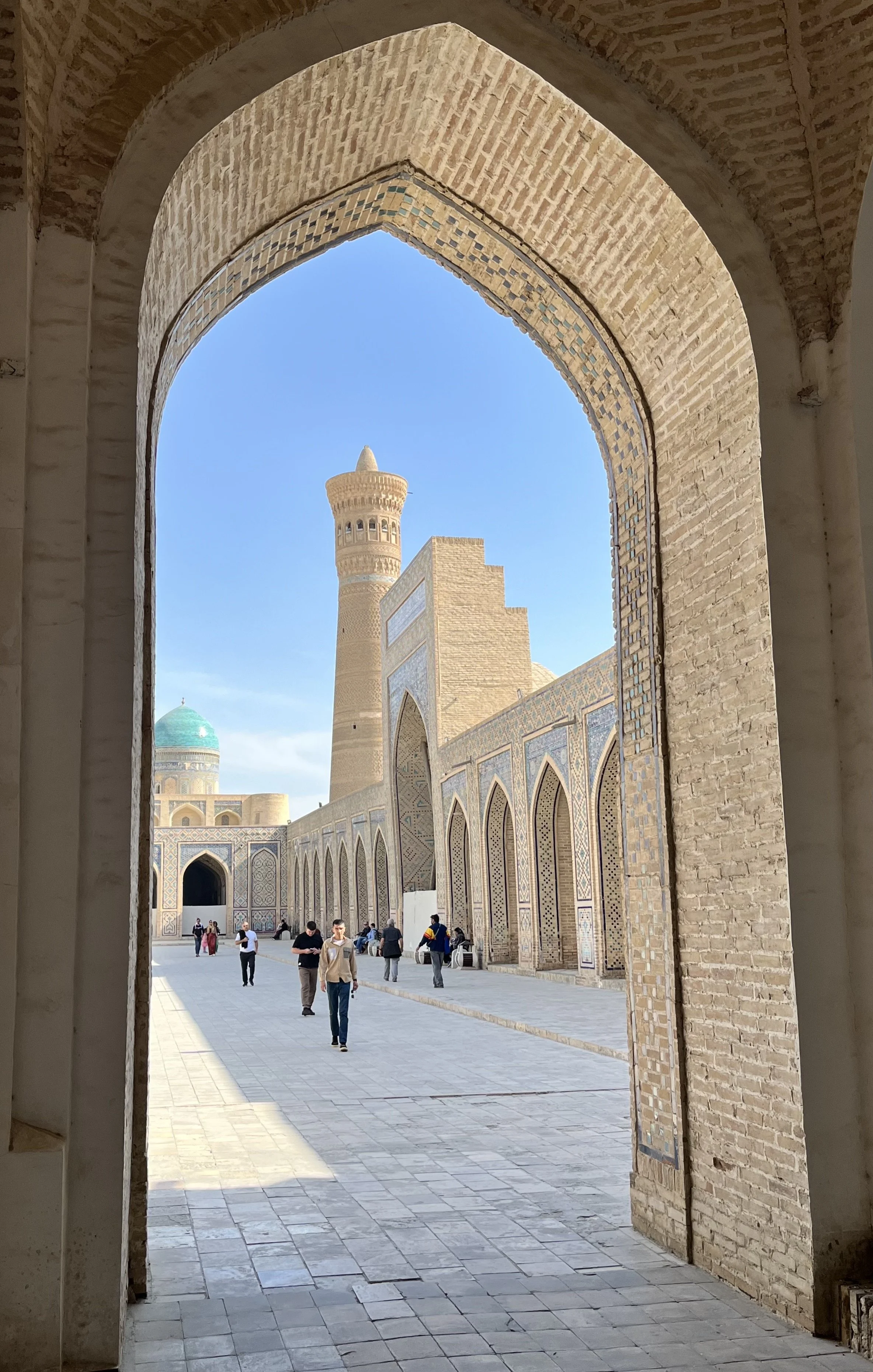
Poi Kalyan is a religious complex with three parts: the Kalan Minaret, the Kalan Mosque, and the Miri Arab Madrasah. The three structures surround a courtyard with the madrasah and mosque at opposite ends. Commissioned by Arslan Khan in 1121, the mosque was destroyed by the armies of Genghis Khan and then rebuilt. Constructed entirely of brick, the 46.5-meter-high Kalan Minaret was built along the foundation of the Kalan Mosque. Brickwork on the minaret includes parallel and turquoise bands. During the Middle Ages it became known as the “Tower of Death” because condemned prisoners were thrown to their deaths from the top. The 130 by 81-meter Kalan Mosque is topped by a large blue dome. The nearby madrasah featured lecture halls and a large rectangular inner courtyard. Its rooms are now used as shops.
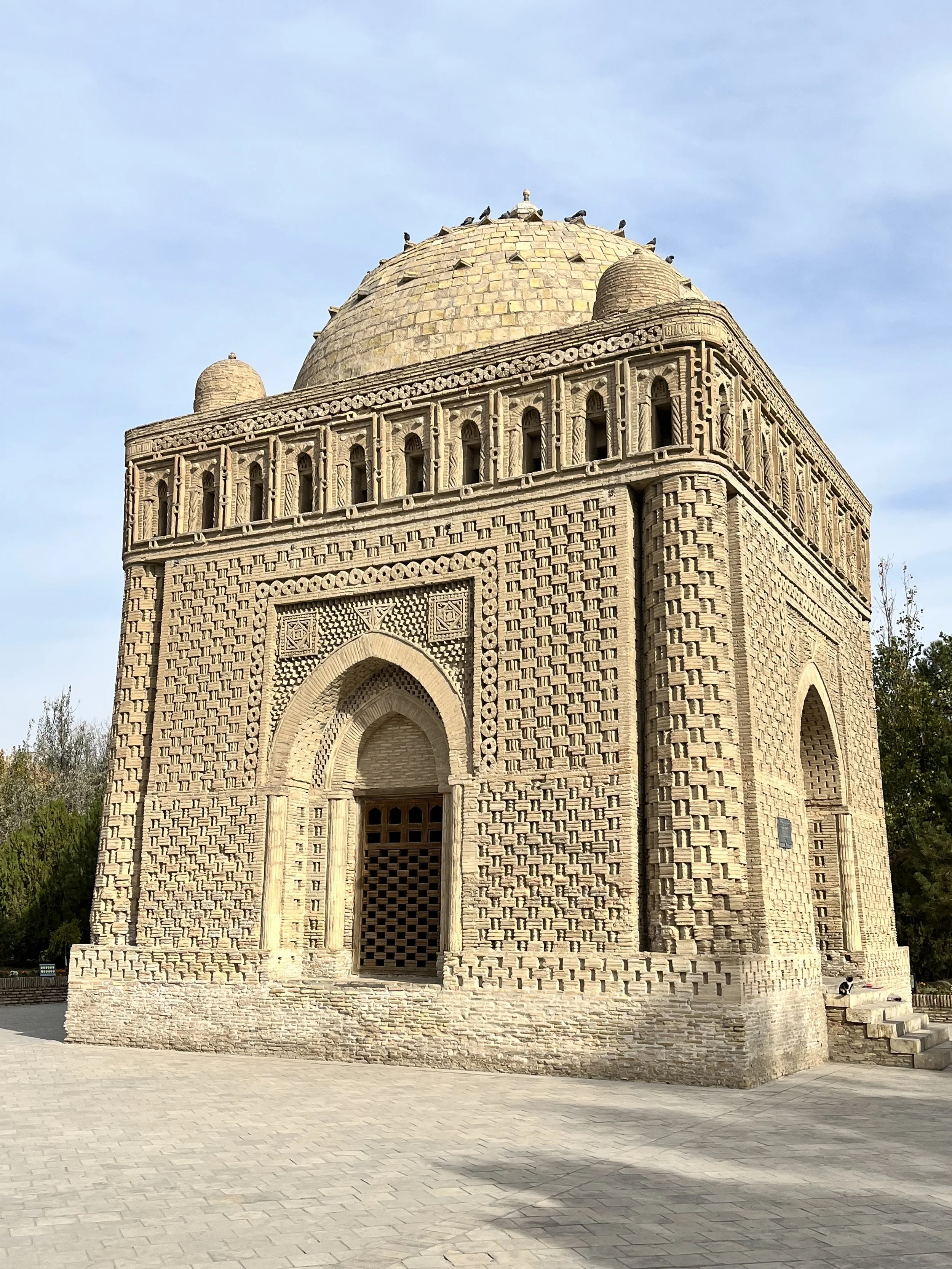
Samanid Mausoleum was constructed in the 10th century for leaders of the Samanid Empire, a dynasty that ruled northern Iran and west-central Asia between 819 and 1005. Constructed out of baked brick, the mausoleum combines elements of Sogdian, Persian, and Byzantine architectural styles and is modeled after Chahar Taq, a type of Zoroastrian fire temple. The cube-shaped building has columns and pointed arches and is topped by a large circular dome. The exterior has patterns representing diamonds, circles, squares, and arches. The tomb was originally located in the center of a cemetery that is now a park. We entered the 10 by 10-meter room through the main door. Inside are three stone monuments. One is the final resting place of Nasr II, leader of the Samanid dynasty from 914 until 943. The tomb is somewhat unusual since Sunni Islam discourages the construction of mausoleums as burial places.
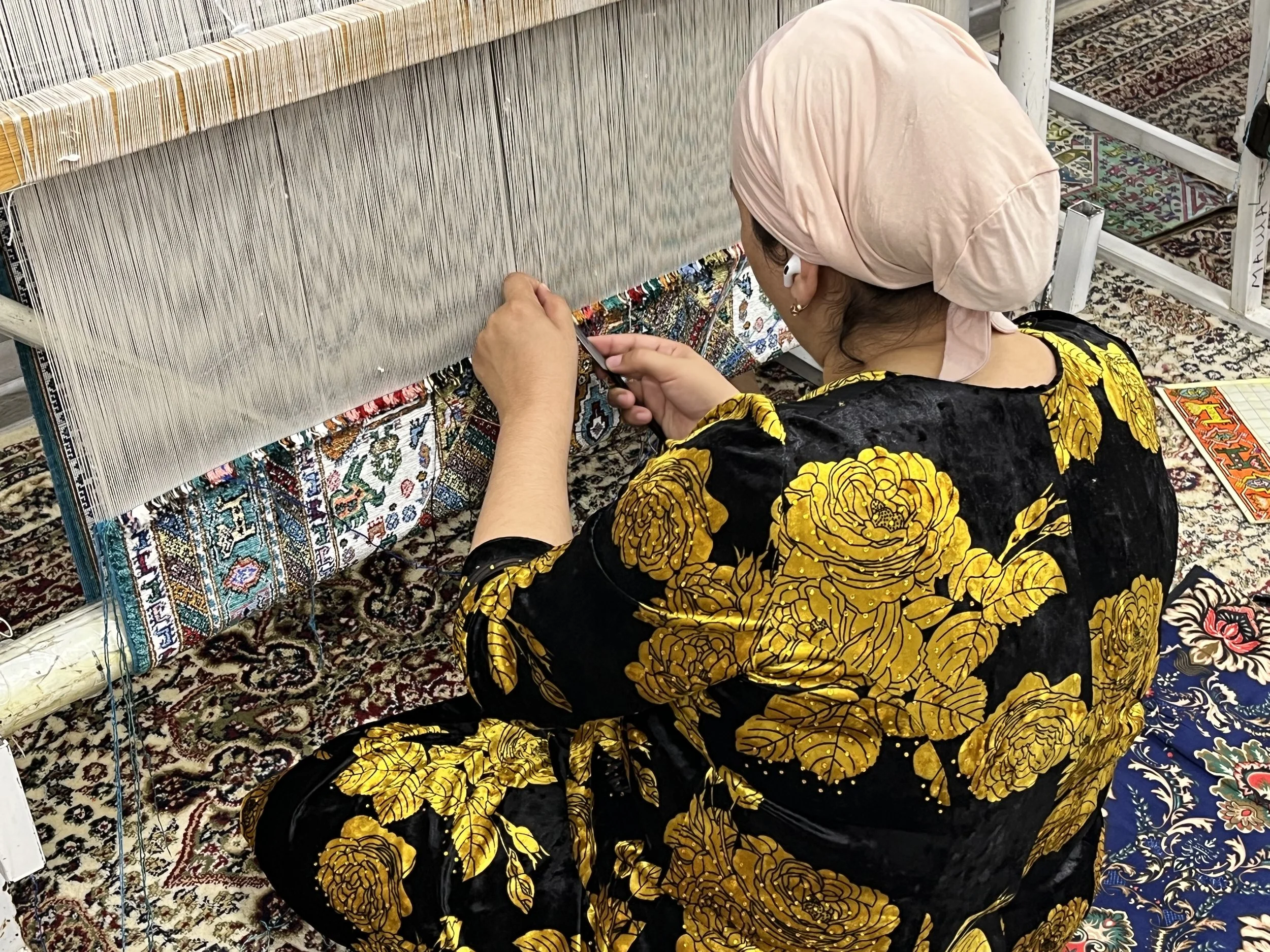
Carpet weaving is a centuries-old tradition in Bukhara. Woven from silk or wool (camel or sheep), hand-crafted Bukharan carpets were in high demand from Europe to China during the era of silk road trade. My travel companions and I had a chance to spend time in a Bukhara carpet factory and showroom. After being served tea and learning about carpet weaving, we were free to explore the factory. Sitting on the floor in front of looms, women use hooks to thread silk or wool strings between vertical strands of fabric stretched between two bars. When only longitudinal and transverse threads are used, the woven surface is known as a kilim. Adding knots creates a pile carpet that is produced in two types: gilyam (short pile) and julkhirs (long pile). Color within strands of material comes from dyes produced using pomegranate (red), onion skins (yellow), or indigo (walnut, pistachio, and apricot). In Uzbek homes carpets may be placed on the floor, hung on a wall, or used to cover windows. Longer carpets are called dzhulkhirs and short carpets, gilams.
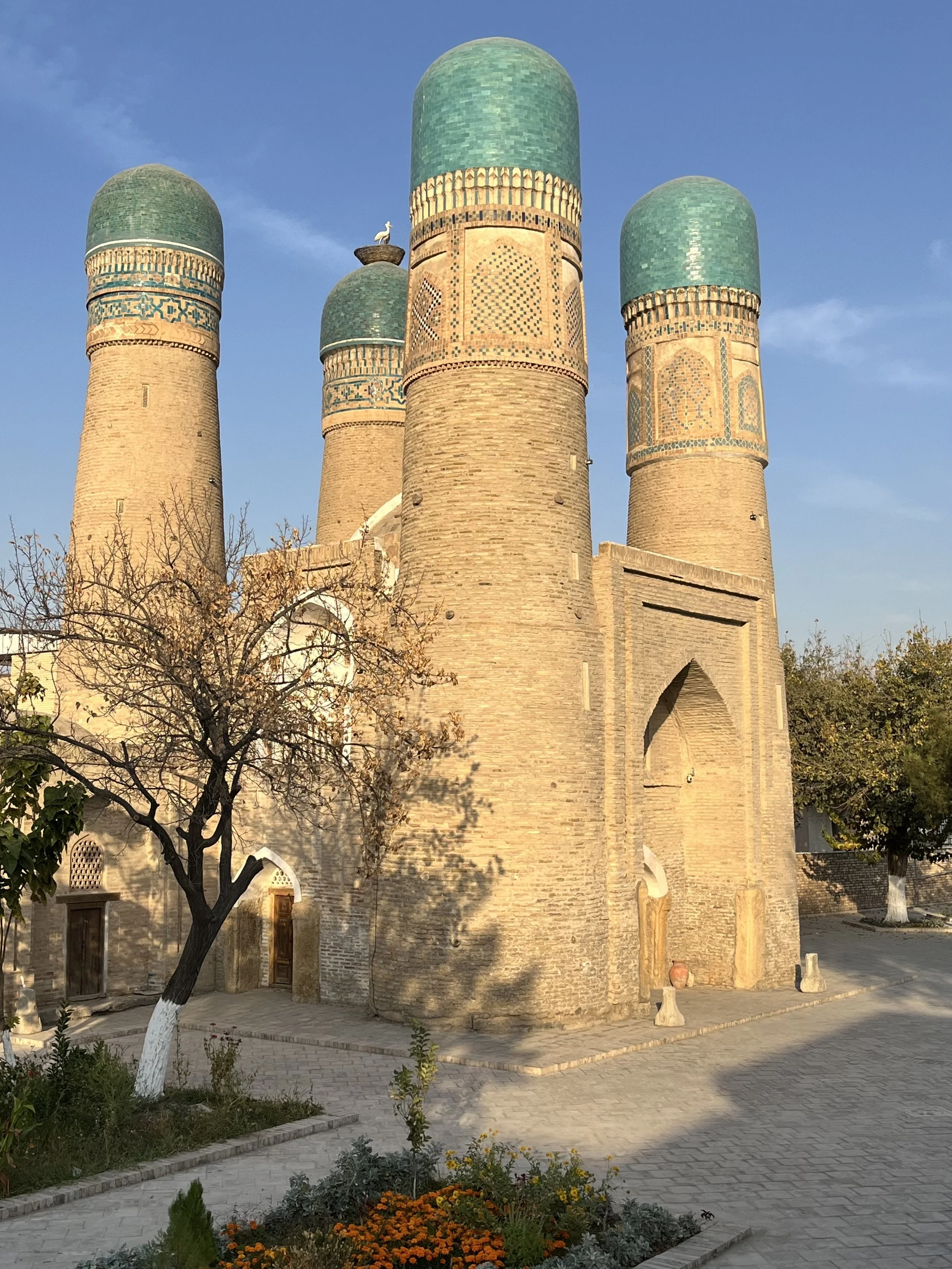
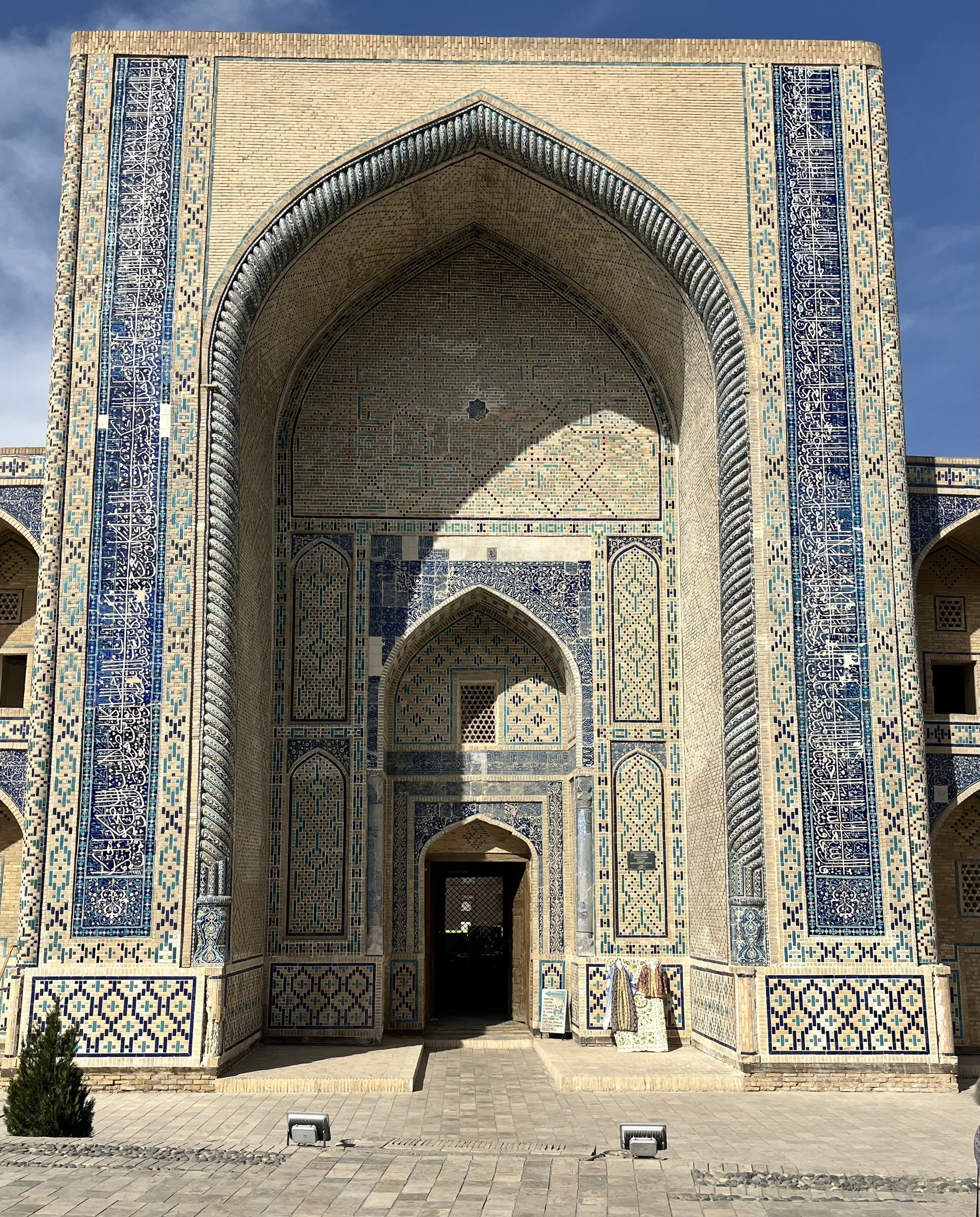
Built in 1807, Chor Minor (aka the Madrasah of Khalif Niyaz-kul) is not an especially old structure compared to others in the city. My wife and I had to use an iPhone mapping application to find the building through a maze of alleys. In Persian, Chor Minor means “four minarets.” The stubby 40 by 90-meter brick building was financed by a wealthy Turkmen merchant named Khalif Niyazkul. Topped by blue ceramic-tiled domes, each of its four minarets is 17 meters tall. Decorated with religious symbols including a Buddhist praying wheel, a Christian cross, and a fish, the building’s four minarets make it look like an up-side-down chair. Functionally, Chor Minor served as the gatehouse for the former madrasah. After flooding from an adjacent stream damaged one of its towers in 1995, a request was made for UNESCO emergency funding to make repairs. I paid an attendant a small fee to climb stairs in one of the towers. Established in 1417, Ulugbek is the oldest preserved madrasah in Central Asia and a model for later schools. Dating to the Timurid dynasty, the building sits opposite of the Abdulaziz Khan Madrasah, forming a single complex that has been called a “double madrasah.” Schools like Ulugbek Madrasah trained religious leaders and men from noble families preparing for government service. Students received theological training and studied math, astronomy, and philosophy. Above the madrasah’s entrance were words that translate to: “The desire for knowledge is the duty for every Muslim.” The building is arranged with a courtyard surrounded by eighty rooms used for tutorials. Upstairs was the library. No longer used as a school, Ulugbek Madrasah is now a museum.
Toqi Zargaron Bazaar (the “cap maker’s bazaar”) is a market for vendors selling folk musical instruments, tableware, carpets, jewelry, textiles, and other locally produced items. The bazaar is also known for its selection of traditional Uzbek headgear including doppi (caps) and telpaks (tall fur hats made from wool). It is also possible to purchase a chapan (robe). The bazaar was also used for trading books and called Kitab-Furushan meaning “dome of book sellers.” The building appears as a group of interconnected domes. It was built in the 16th century under the rule of Abdullah Khan II (1533-98) to provide a venue for silk road merchants. Called “currents,” the bazaar’s domes were constructed out of clay, stone, adobe, and wood. A main dome (38 meters in diameter) is surrounded by several smaller domes and inside are arched niches. Arranged around the central dome are former caravanserais (rooms for travelers) along with storage/warehouse space. Silk road traders stayed in the caravanserais on long journeys to Europe, the Russian Empire, Iran, or China.
