Uzbekistan. Medieval City of Thieves and Slaves
Located in south-central Uzbekistan, Khiva has been described as a living museum and the best-preserved medieval city on the ancient silk roads. To Khiva’s south is Turkmenistan and the Karakum Desert and to its northwest is the Kyzylkum Desert. Established more than 2,500 years ago, the city was dominated by Persians until Turks arrived in the 10th century. A legend says that the city was founded by Shem, one of Noah’s sons. When he found the site, it is believed that Shem exclaimed Khey vakh! (meaning "sweet water"). Later Khiva was conquered by Genghis Kahn during the Mongol invasion of Central Asia (1219 to 1221).
By the 17th century Khiva had become capital of the Khanate Khiva (a khanate is a political entity ruled by a khan or leader). Khiva’s location near the Karakum Desert made it an ideal location for selling men and women captured by Turkmen tribesmen. With thousands of Persians and Russians sold as slaves, Khiva became known as the “city of thieves and slave traders.” Bartered like cattle, artisans brought twice the price of laborers and a Russian was worth the equivalent of four camels or two good horses. The slave trade was finally abolished in 1853. Khiva fell to the Russians in 1873 and in 1919, the city became part of the Khorezm People’s Soviet Republic. Among its most prominent buildings is the 56-meter-tall Khoja Minaret which features alternating bands of blue glazed tiles and sand-colored bricks. Today, Khiva has the distinction of being the first (1990) UNESCO World Heritage Site in Central Asia.
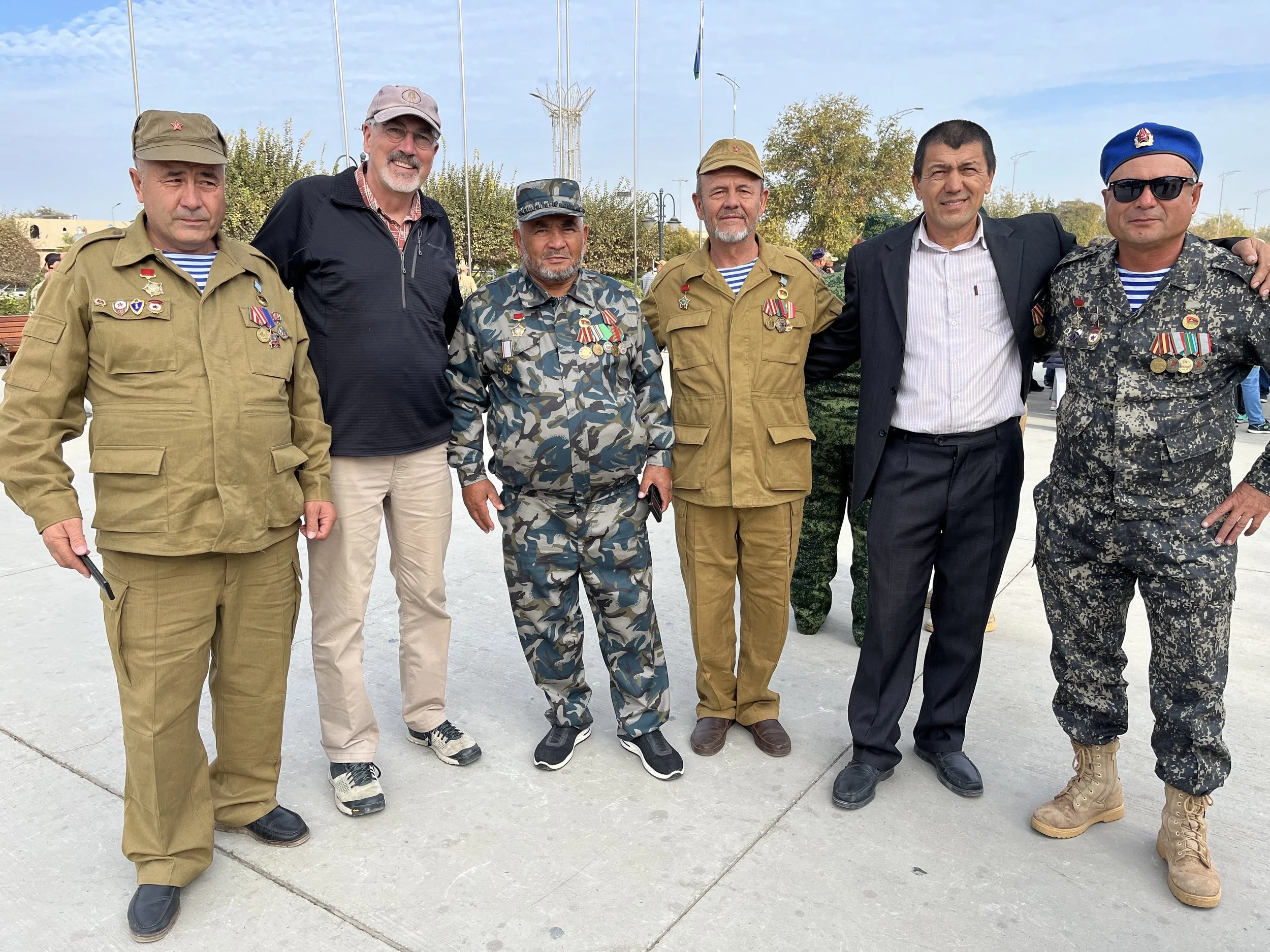
On my second day in Khiva my companions and I met in a large plaza near the entrance to the old city. Near the main gate were about two dozen middle-aged men, most dressed in military uniforms. Our guide explained that the men were here for a reunion of Afghan War (1979-89) veterans. Soviet military personnel entered Afghanistan to assist the pro-Soviet AKP Party against Mujahideen guerilla forces supported by Pakistan, the U.S., the UK, China, Iran, and Arab states. At the time Soviet leaders viewed Afghanistan as a buffer to prevent western influences and block Islamic extremism. More than 65,000 Uzbek men and women fought within Soviet military units deployed to Afghanistan and 1,500 were killed along with more than three million Afghans. Today, many political scientists cite the conflict as a significant factor in the breakup of the Soviet Union. The men were extremely friendly and willing to pose for photos.
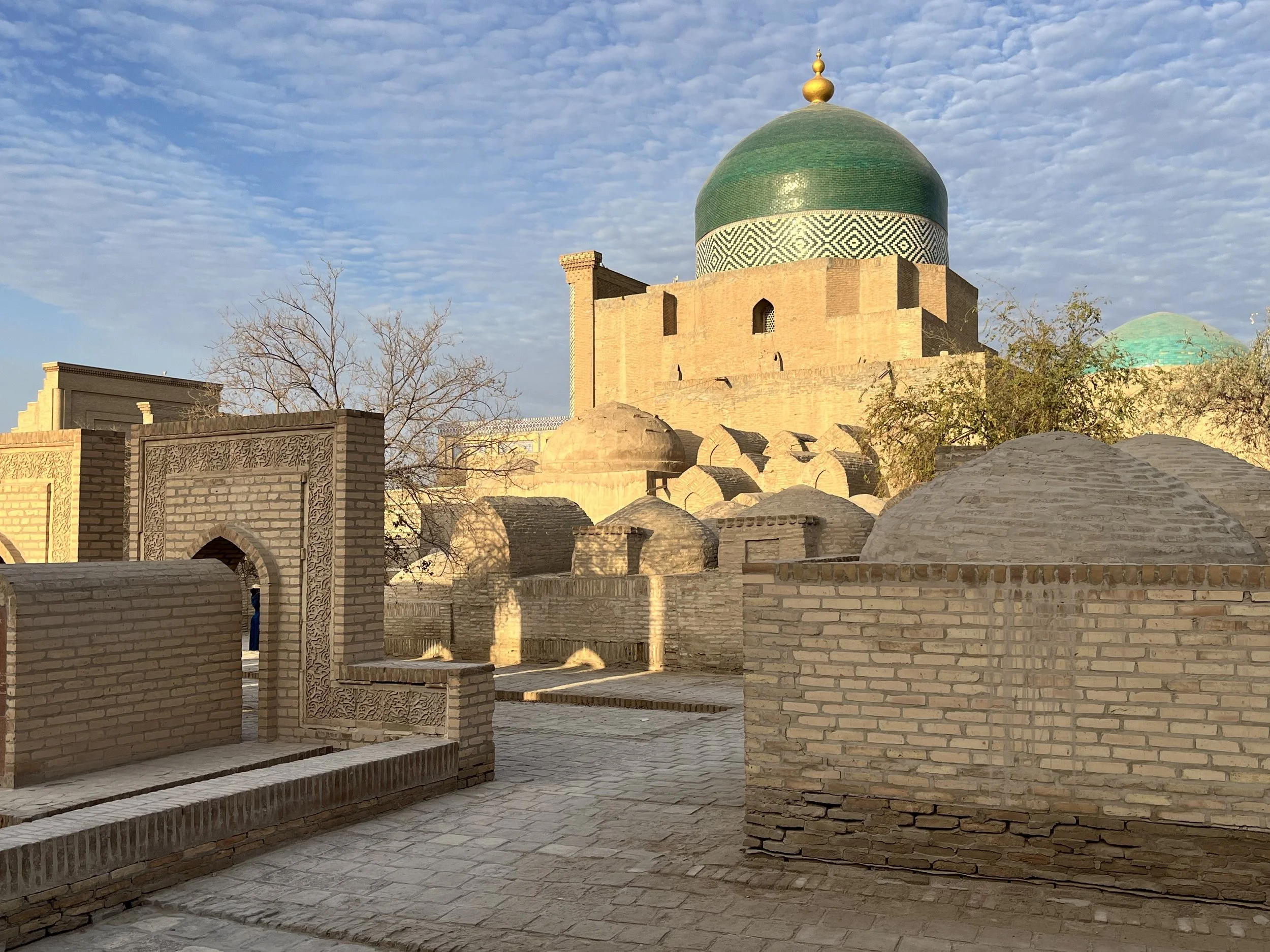
The older section of Khiva has two parts, an outer town (Dichan Kala) protected by a wall with eleven gates, and an inner town (Itchan Kala) encircled by a 10-meter-high brick wall where automobiles are prohibited. Many of Itchan Kala’s buildings including mosques and madrasahs date to the 12th century or before including Djuma Mosque which features 200 carved wooden pillars. There are a few palace buildings that were constructed between 1780 and 1850. The Pahlavon Mahmud Complex contains the tomb of Pahlavon Mahmud, a well-known 14th century wrestling champion, poet, and teacher. Revered as the patron of Khiva, Mahmud’s mausoleum is covered by a blue tiled dome. It was built in 1701 by Shohniyoz Khan to replace an older wooden structure. The destination for many pilgrimages, the mausoleum complex has expanded with the addition of Sufi lodges and mosques.
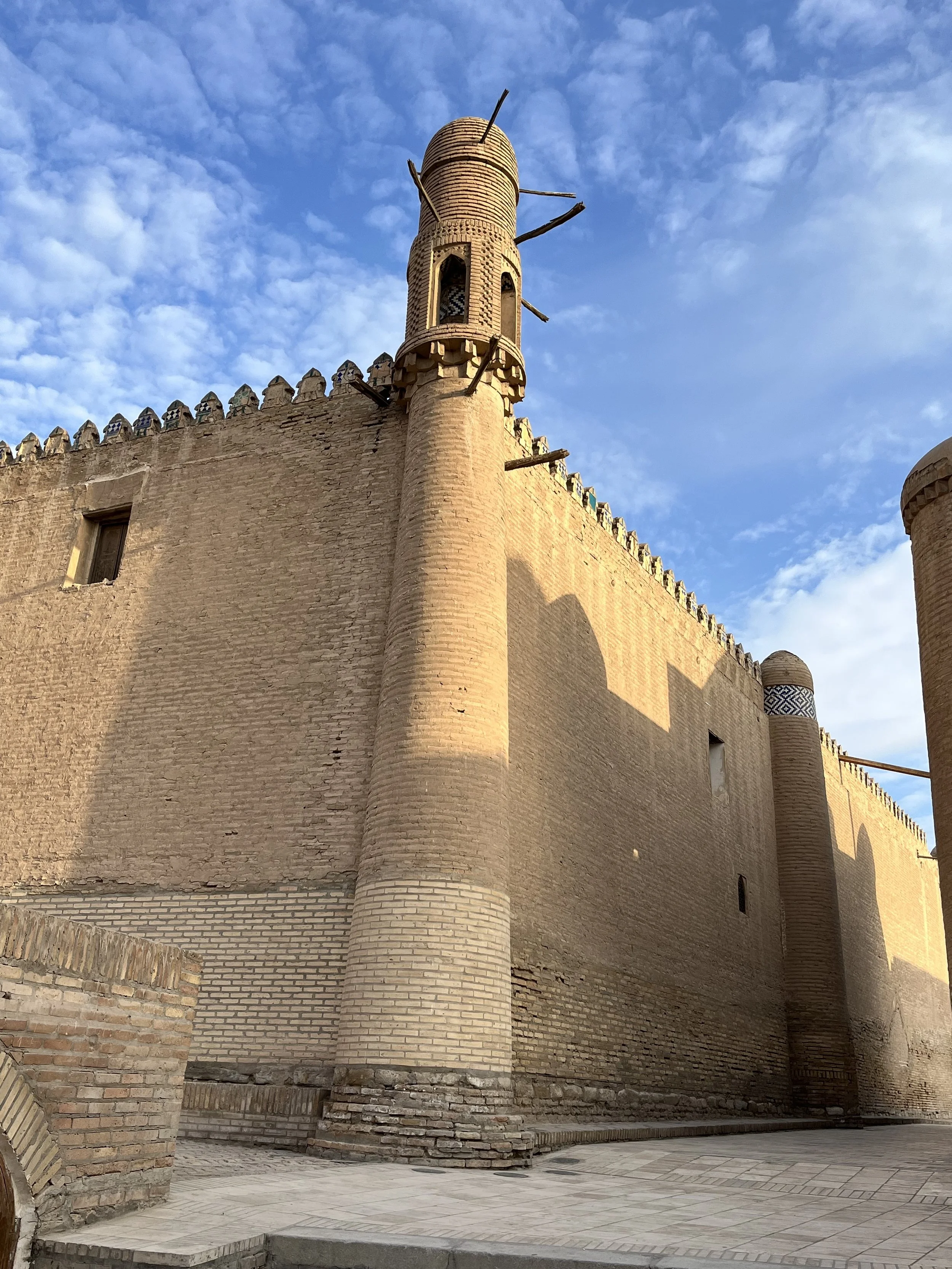
Completed in 1841 for Allah Kuli Bahadur Khan (who ruled from 1826 to 1842), the palace of Tash-Khovli is located within Itchan Kala. It features 260 rooms and three courtyards. One of its courtyards provides access to four apartments that were assigned to each of the Khan’s four wives. A fifth apartment was used by the Khan himself. We walked through a secret corridor used by the Khan for access to members of his harem. The Khan received guests in a room called the Ichrat Khaouli. Before being brought to Tash-Khovli in 1872, British army officer Frederick Burnaby was greeted at the palace’s gatehouse by a guard of “…forty men armed with scimitars all attired in long flowing silk robes.” There was also a room called the Arz Khaouli which served as a court of justice. The room had two exits, one for persons who were acquitted and a heavily guarded door for persons to be imprisoned or executed.
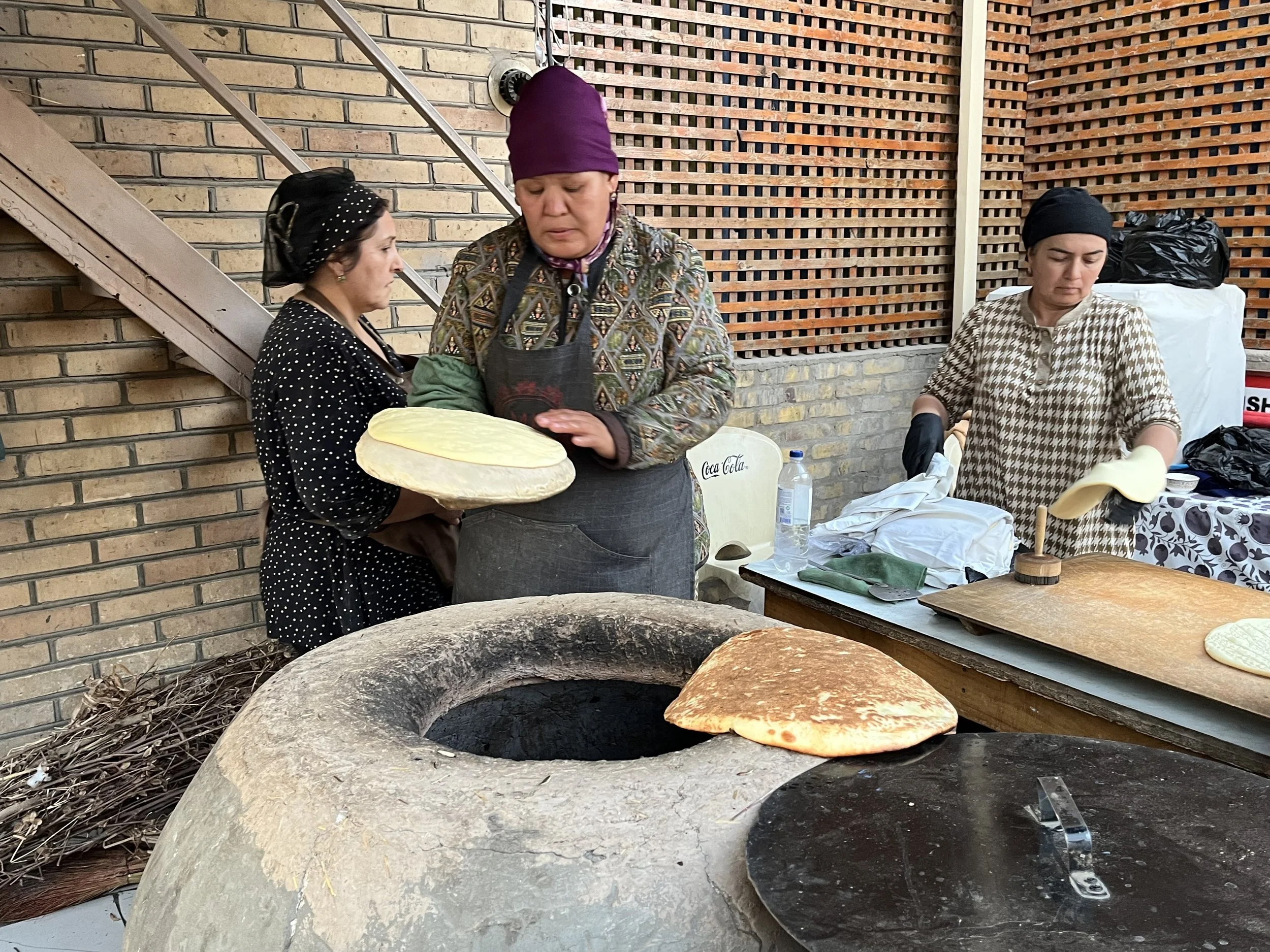
Bread is sacred in Uzbek culture and broken by tearing rather than cutting. It is considered poor etiquette to place bread upside-down during meals. Traditional Uzbek bread, known as lepeshka or non, is baked in a clay oven called a tandir (similar to tandoori ovens used in India). The oven is prepared by burning coal or firewood for several hours. The tandir’s walls are then covered with salt so that loaves of bread are easier to separate. Round and flat, the bread is decorated with a stamp called a chekich. It takes about 30 minutes for loaves to be baked and when finished, they are a golden-brown color. Uzbek bread is an important food during weddings and is broken by the parents of the bride and groom as a symbol of unity.